

Table of Contents
- What Are the THE Asia University Rankings?
- India’s Performance in 2026 — The Full Picture
- IISc at 43: A Closer Look
- Top Indian Universities in THE Asia 2026
- How the Rankings Work: Eligibility & Criteria
- Who’s Leading Asia? Top 10 Breakdown
- Why Can’t India Break the Top 40?
- What This Means for Students
- Key Takeaways
- FAQs
What Are the THE Asia University Rankings?
The Times Higher Education Asia University Rankings are published annually by the UK-based education analytics company Times Higher Education. The 2026 edition is the largest yet, featuring 929 universities across 36 countries and territories — up from 853 institutions in 2025. These rankings use the same 18 performance indicators as the global THE World University Rankings, but the weightings are recalibrated to reflect the specific priorities of Asian higher education systems. The five core pillars are:Teaching
Learning environment quality, staff-to-student ratio, doctorate ratio, and institutional income.Research Environment
Research income, reputation survey scores, and research productivity per faculty.Research Quality
Citation impact, research strength, excellence, and influence metrics.International Outlook
International students, international staff, and international co-authorship of research.Industry Income
Knowledge transfer — how much industry funds university research and innovation activities.Release Date: The THE Asia University Rankings 2026 were officially released on April 23, 2026, at 21:00 CST. The full table is live on the Times Higher Education website.
India’s Performance in 2026 — The Full Picture
Here’s the paradox of India’s 2026 showing: more universities are ranked than ever before, yet the top-tier institutions are further down the table than in previous years.- India is the most-represented country in THE Asia 2026, with 128 universities — a dramatic increase from just 19 institutions in 2016.
- However, no Indian university entered the top 40 this year, which represents a meaningful step back from the country’s recent trajectory.
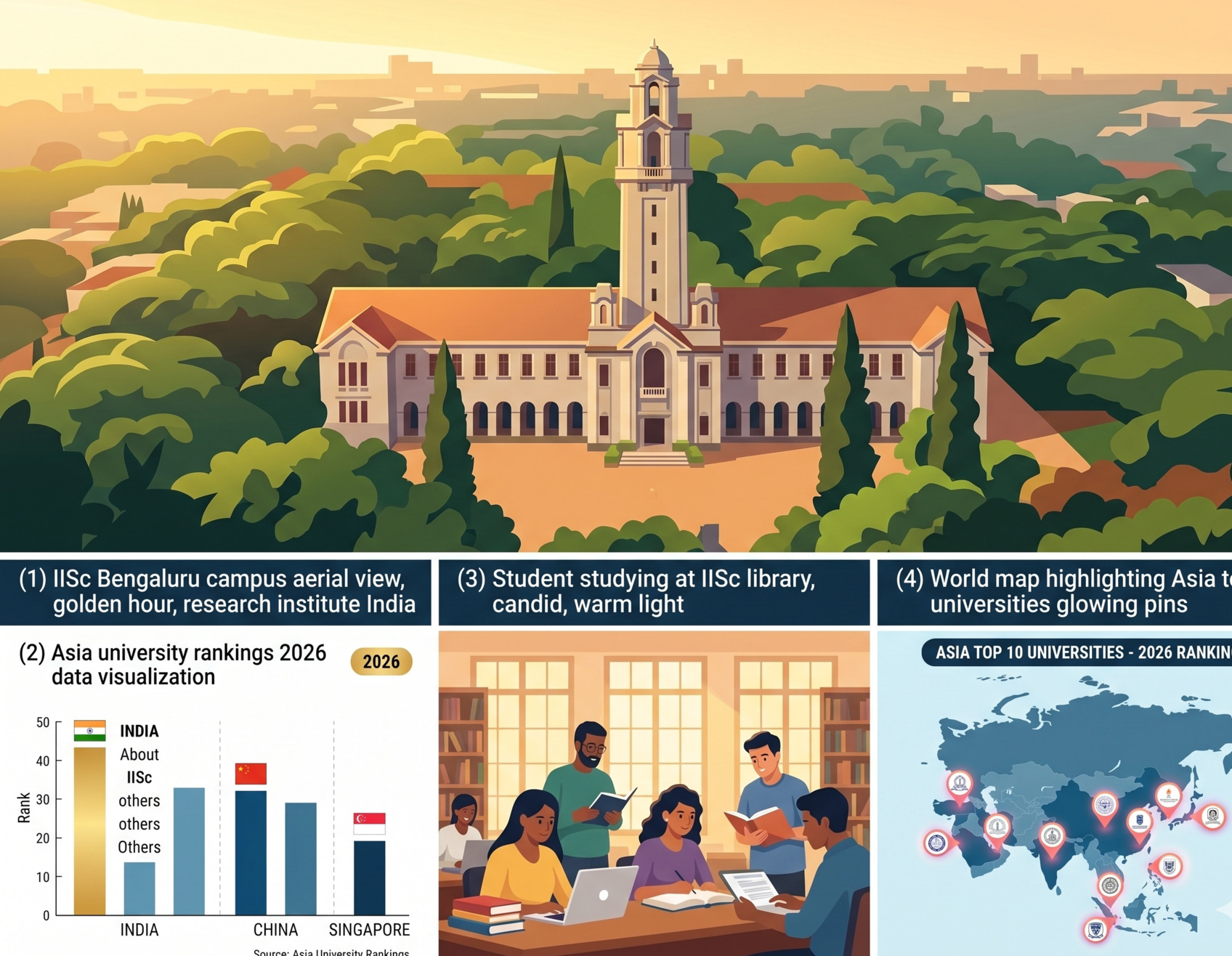
- IISc Bengaluru holds on as the sole Indian institution in the top 50, ranked 43rd (down from 38th last year).
- India has 12 institutions in the top 200, which reflects solid mid-tier strength.
- Lovely Professional University, Manipal Academy, Thapar Institute, and Delhi University are all jointly ranked at 197th, up from the 201–250 band previously.
IISc at 43: A Closer Look
The Indian Institute of Science (IISc), Bengaluru has long been India’s standard-bearer in global and regional rankings. Founded in 1909 and located in the heart of India’s science and technology hub, IISc is a research-only institution — it awards no undergraduate degrees, focusing entirely on postgraduate research and doctoral programs. In the THE Asia Rankings 2026, IISc ranked 43rd overall — a drop of five places from its 38th position in 2025. Despite the slide, this is significant context:- IISc is the only Indian university in the top 50 of THE Asia 2026.
- It remains the sole Indian representative in the top 100 (for the THE Asia edition specifically).
- IISc’s strength lies in research citations and academic reputation — areas where it consistently punches above India’s average weight.
- Its biggest relative weakness, like most Indian universities, remains international outlook — the proportion of international students and international faculty.
“While India has improved its overall representation in the rankings, the data indicates that breaking into the top tier remains a challenge, with IISc continuing to carry the country’s presence in the top 50.”— THE Asia University Rankings 2026 Analysis
Top Indian Universities in THE Asia Rankings 2026
Beyond IISc, India has a growing cluster of institutions in the 100–200 band. Here is the current picture of India’s strongest performers:| Asia Rank | Institution | Location | Change vs 2025 |
|---|---|---|---|
| 43 | IISc Bengaluru | Bengaluru, Karnataka | ▼ 5 (was 38th) |
| 101–150 | IIT Bombay | Mumbai, Maharashtra | ▼ Slipped |
| 101–150 | IIT Delhi | New Delhi | ▼ Slipped |
| 151–200 | IIT Madras | Chennai, Tamil Nadu | Stable |
| 151–200 | IIT Roorkee | Roorkee, Uttarakhand | Stable |
| 197 | Lovely Professional University | Phagwara, Punjab | ▲ Up (was 201–250) |
| 197 | Manipal Academy of Higher Education | Manipal, Karnataka | ▲ Up (was 201–250) |
| 197 | Thapar Institute of Engineering | Patiala, Punjab | ▲ Up (was 201–250) |
| 197 | University of Delhi | New Delhi | ▲ Up (was 201–250) |
How the Rankings Work: Eligibility & Key Requirements
Understanding the ranking methodology is essential — both to interpret results and to understand what Indian universities must improve. Here’s how THE Asia Rankings determine who gets listed and where.Eligibility Requirements for Universities
- Must teach undergraduates: Pure research institutions get a waiver, which is how IISc qualifies despite being research-only.
- Must have significant research activity — typically publishing more than 1,000 research papers over a 5-year period (indexed in Elsevier’s Scopus database).
- Cannot specialize only in one narrow area — universities that focus exclusively on a single field (medicine, technology) may require a separate subject ranking.
- Annual data submission is mandatory — universities must submit verified institutional data to THE each year to be included.
The 18 Performance Indicators
THE uses 18 metrics grouped into five pillars. For Asia specifically, the weighting shifts — research quality and international outlook carry significant weight:Teaching (25%)
Staff-to-student ratio, doctorate awards, institutional income, reputation surveys among academics.Research Environment (28%)
Research income, research productivity, academic reputation in research.Research Quality (30%)
Citation impact, research excellence — the biggest single pillar in THE rankings.International Outlook (7.5%)
Ratio of international students, international staff, and international co-authored research.Industry Income (2.5%)
Revenue from industry partnerships and knowledge transfer activities.Who’s Leading Asia? The Top 10 Breakdown
China continues its dominance, holding five of the top 10 spots in the 2026 edition. Singapore, Hong Kong, and Japan round out the elite tier.| Rank | University | Country |
|---|---|---|
| 1 | Peking University | China |
| 2 | Tsinghua University | China |
| 3 | National University of Singapore (NUS) | Singapore |
| 4 | Nanyang Technological University (NTU) | Singapore |
| 5 | University of Hong Kong (HKU) | Hong Kong |
| 6 | Hong Kong University of Science & Technology | Hong Kong |
| 7 | Fudan University | China |
| 8 | Zhejiang University | China |
| 9 | Shanghai Jiao Tong University | China |
| 10 | University of Tokyo | Japan |
Why Can’t India Break the Top 40? The Real Reasons
This is the question that matters most. With 128 universities in the ranking and a booming STEM ecosystem, why does India still struggle at the elite tier?1. Internationalisation Gap
Indian universities enroll very few international students and employ relatively few international faculty. In the THE methodology, this directly impacts the International Outlook pillar. Singapore’s NUS, by contrast, draws students and researchers from 100+ countries, boosting its scores significantly.2. Research Citation Impact
While India produces a large volume of research papers, the impact — measured by how often those papers are cited by other researchers globally — still lags behind China, Singapore, and South Korea. Quality of research, not just quantity, drives rankings.3. Industry Income & Knowledge Transfer
Indian universities receive comparatively less research funding from industry. The innovation-to-industry pipeline — where university research leads to commercial products and corporate R&D funding — is still maturing in India compared to places like Singapore and China.4. Faculty Metrics
Student-to-faculty ratios at large Indian public universities remain a challenge. IITs generally do better here, but many institutions lack enough PhD-holding faculty to match top Asian competitors.The opportunity: India’s biggest potential gains are in internationalisation and research citation impact — both areas that can be improved through policy, funding, and international partnerships without requiring decades of institutional rebuilding.
What This Means for Students — Practical Takeaways
If you’re a student deciding where to study, or a researcher weighing your options, here’s what the 2026 rankings tell you in plain terms:- IISc remains India’s gold standard for research-focused postgraduate and doctoral education. If research is your goal, it’s still the top choice in India.
- IITs are globally competitive — even if their Asia rank slipped, they remain among the best engineering and technology institutions in the world for undergraduate and master’s programs.
- Private universities are climbing — Manipal, LPU, and Thapar’s improved positions reflect growing infrastructure investment and research output in India’s private university sector.
- Singapore, Hong Kong, and China offer unmatched Asian alternatives for students open to studying abroad, especially at the postgraduate level.
- Rankings are one lens, not the whole picture — placements, research output in your specific field, faculty access, and cost of living matter far more for your actual outcome.
Key Takeaways
- THE Asia University Rankings 2026 released April 23, 2026 — 929 universities, 36 countries.
- IISc Bengaluru ranks 43rd in Asia — India’s top, but down five places from 38th in 2025.
- No Indian university entered the top 40; IISc is the sole Indian institution in the top 50.
- India is the most-represented country with 128 universities, up from 107 last year.
- China dominates the top 10, holding five spots; Peking and Tsinghua lead Asia.
- Malaysia and Macao made historic ranking breakthroughs in 2026.
- India’s key gaps: internationalisation and research citation impact.
- Private Indian universities like Manipal and LPU are rising in mid-tier rankings.
Conclusion
The THE Asia University Rankings 2026 paint a picture of an India that is growing rapidly in breadth but still climbing slowly in depth. IISc at 43rd is a symbol of genuine research excellence — and also a reminder of how much further India’s elite institutions need to travel to match Asian peers in Singapore, China, and Hong Kong. The path forward is well understood: more international faculty, stronger industry-research linkages, and a relentless focus on research quality over research volume. The policy will, the funding, and the talent base exist in India. The question is how quickly the system can convert potential into ranking performance. For students, the message is simple: an Indian degree from IISc or the IITs remains globally valuable and respected — rankings are a useful signal, not a verdict.FAQs
- Which Indian university ranks highest in THE Asia University Rankings 2026?
The Indian Institute of Science (IISc), Bengaluru, is India’s highest-ranked university in the THE Asia University Rankings 2026, placed at 43rd. It is the only Indian institution in the top 50 and top 100 of this edition.
- Did any Indian university rank in the top 40 of THE Asia Rankings 2026?
No. Despite India’s strong overall representation with 128 universities listed, no Indian institution entered the top 40. IISc came closest at 43rd, having slipped from 38th in the 2025 edition.
- When were the THE Asia University Rankings 2026 released?
The Times Higher Education Asia University Rankings 2026 were officially released on April 23, 2026, at 21:00 CST. Results are available on the THE website at timeshighereducation.com.
- How many Indian universities are in the THE Asia Rankings 2026?
India has 128 universities featured in the THE Asia University Rankings 2026 — making it the most-represented country in the entire ranking, ahead of Japan (115) and Turkey (109).
- What is the eligibility criteria for universities to be included in THE Asia Rankings?
Universities must teach undergraduates (or be pure research institutions like IISc), publish at least 1,000 research papers over five years (indexed in Scopus), not be single-subject focused, and submit verified data annually to Times Higher Education. Rankings are assessed across 18 performance indicators grouped into teaching, research environment, research quality, international outlook, and industry income.
- Which country tops the THE Asia University Rankings 2026?
China dominates, holding five of the top 10 positions. Peking University and Tsinghua University hold the top two spots. Singapore, Hong Kong, and Japan also feature in the top 10.
- Why are Indian universities not in the top 40 of Asian rankings?
The main factors are low internationalisation (few international students and faculty), relatively lower research citation impact compared to Chinese and Singaporean peers, limited industry research funding, and faculty capacity constraints. These are known gaps that Indian policymakers and institutions are actively working to address.
Applications Open Now
Next article
NSUT Admission 2026 guide eligibility, JEE Main entrance details, JAC Delhi counselling dates, selection process, cutoffs & documents