

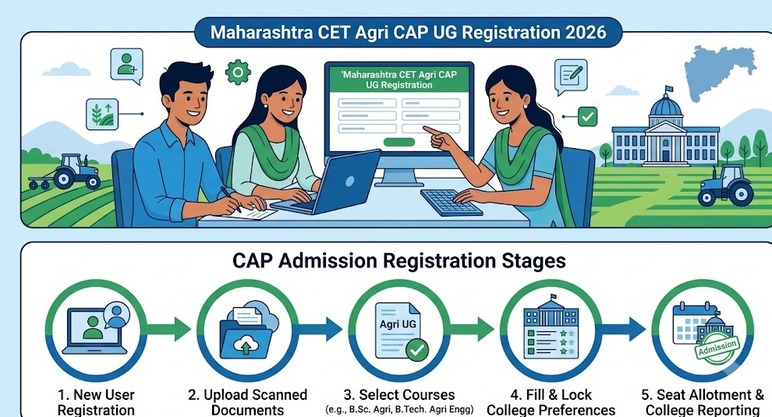
If you dream of building a career in agriculture, agricultural engineering, food technology, or biotechnology, there’s big news waiting for you. The Maharashtra State Common Entrance Test (CET) Cell has officially opened registration for undergraduate admissions to BSc (Honours) Agriculture, BTech Agricultural Engineering, BTech Biotechnology, and several other agriculture-allied courses for the Academic Year 2026–27.
This is one of the most anticipated admission windows for science students in Maharashtra every year, and thousands of aspirants compete for limited seats across government and private agricultural universities. Missing a date or a document requirement can cost you an entire academic year — so getting the details right matters.
In this guide, you’ll learn:
- What courses are covered under this CAP (Centralized Admission Process) round
- Key registration dates and the application timeline
- Eligibility criteria for each course
- Step-by-step registration process
- Required documents
- Common mistakes to avoid
- Tips to improve your admission chances
What Is the Maharashtra CET Cell Agriculture Admission Process?
The State Common Entrance Test Cell, Maharashtra, under the state’s Higher and Technical Education Department, conducts a Centralized Admission Process (CAP) for various professional degree courses every year. This includes engineering, pharmacy, MBA — and importantly, agriculture and allied science courses.
For the 2026–27 academic year, the CET Cell has activated the Agri UG CAP candidate registration on its official portal, allowing students to apply for seats in agricultural universities across Maharashtra, including institutions affiliated with:
- Mahatma Phule Krishi Vidyapeeth (MPKV), Rahuri
- Dr. Panjabrao Deshmukh Krishi Vidyapeeth (PDKV), Akola
- Vasantrao Naik Marathwada Krishi Vidyapeeth (VNMKV), Parbhani
- Dr. Balasaheb Sawant Konkan Krishi Vidyapeeth (BSKKV), Dapoli
Admission is based on scores from MHT-CET 2026 (PCM or PCB group), JEE Main, or NEET, depending on the course you’re applying for.
Courses Covered Under Agri UG CAP 2026-27
According to the official notification, admissions are open for nine professional degree programmes in agriculture and allied sciences. These broadly include:
- BSc (Honours) Agriculture
- BSc (Honours) Horticulture
- BSc (Honours) Forestry
- BSc (Honours) Community Science
- BSc (Honours) Agri-Business Management
- BTech Agricultural Engineering
- BTech Food Technology
- BTech Biotechnology
- BFSc (Bachelor of Fisheries Science)
There’s also a provision for Direct Second Year admission to BSc Agriculture for eligible diploma holders.
Group Requirement by Course
| Course | Required CET Group |
|---|---|
| BSc Agriculture, Horticulture, Community Science, Agri-Business Mgmt, BTech Biotechnology | PCM or PCB |
| BTech Agricultural Engineering | PCM only |
| BSc Forestry, BFSc Fisheries Science | PCB only |
This distinction matters a lot — choosing the wrong CET group can make you ineligible for a course you actually want.
Important Dates
The CET Cell activated the Agri UG CAP candidate registration on its official website in early July 2026, alongside similar CAP registration windows for BE/BTech and MBA/MMS courses that opened on July 2, 2026.
Because CAP schedules for agriculture courses are notified separately and can shift by a few days, always cross-check the live schedule on the CET Cell’s official pages before you plan around any date:
- Official CAP portal: cetcell.mahacet.org/cap-_2026-27
- Agriculture course info page: cetcell.mahacet.org/agri2026
Practical tip: Bookmark the official notices page and check it every 2–3 days during the admission season. Agricultural CAP schedules are usually announced through downloadable PDF notices, not just a banner update — so read every circular carefully.
Eligibility Criteria
While exact eligibility varies slightly by course, the general requirements are:
- Candidate must have passed 10+2 (Science stream) from a recognized board with Physics, Chemistry, and either Mathematics or Biology.
- A valid score in MHT-CET 2026, JEE Main, or NEET (as applicable to the chosen course).
- Maharashtra domicile candidates get priority for state-quota seats; All India and NRI/OCI candidates can apply under separate categories.
- Candidates without Biology or Mathematics in Class 12 may need to complete “deficiency courses” prescribed by the respective agricultural university before final admission.
- No upper age limit is specified for MHT-CET, but individual universities may have their own norms — check the relevant information brochure.
Example: A student who studied PCM (Physics, Chemistry, Mathematics) without Biology can still apply for BTech Agricultural Engineering directly, but if they want BSc Agriculture (Honours), they may be asked to clear a bridge/deficiency course in Biology during the first year.
Registration Guide
Here’s how to complete your Agri UG CAP registration:
- Visit the official portal — cetcell.mahacet.org — and look for the “Admission Process A.Y. 2026-27” link.
- Click on Agri UG CAP registration for agriculture and allied courses.
- Create your login using your email ID, mobile number, and MHT-CET/JEE/NEET application number.
- Fill in personal, academic, and category details carefully — this data is used for merit list generation.
- Upload required documents (see next section) in the specified format and size.
- Pay the application/registration fee through the online payment gateway.
- Complete document verification — either through e-Scrutiny (online) or at a designated Facilitation Centre (physical).
- Fill your college and course preferences (choices) once the merit list is published.
- Track your seat allotment and confirm/report to the allotted institute within the given deadline.
Pro tip: Fill in as many college-course preferences as possible in the choice form. Even if you’re confident about your top choice, having a longer preference list protects you from missing out on a seat entirely if your first few options don’t come through in a particular round.
Documents Required
Keep these scanned copies (in the correct size/format) ready before you start:
- Class 10 and Class 12 mark sheets and passing certificates
- MHT-CET / JEE Main / NEET scorecard
- Domicile certificate (for Maharashtra quota)
- Nationality certificate
- Caste certificate and caste validity certificate (if applicable)
- Non-creamy layer certificate (for OBC/reserved categories, if applicable)
- Income certificate (for EWS or fee concession schemes)
- Aadhaar card
- APAAR ID (increasingly mandatory for CET admissions)
- Passport-size photograph and signature (as per specified guidelines)
- Gap certificate (if there’s a break in education)
Practical note: Aadhaar and APAAR ID are now mandatory requirements in the MHT-CET ecosystem. If you don’t have an APAAR ID yet, generate it well in advance through your school/college — it can take a few days to process.
Overview
Application and registration fees vary by category (Open, SC/ST, OBC, EWS, PWD) and are revised periodically. For MHT-CET 2026, the fee for the general category was increased, so expect a similar structure for CAP-level agriculture registration.
- Fees are typically lower for reserved category candidates.
- Additional charges may apply for physical document scrutiny versus online e-Scrutiny.
- Always pay through the official portal only — never through third-party links or agents claiming to “confirm” your seat for a fee.
Benefits of Applying Through CAP
- Transparency: Merit-based, rule-driven seat allotment reduces bias.
- Wide institute access: A single registration gives you access to dozens of government, university-managed, and private agricultural colleges.
- Reservation benefits: Category-based reservations (SC/ST/OBC/EWS/PWD) are automatically applied during allotment.
- Multiple rounds: If you don’t get your preferred seat in round one, subsequent CAP rounds give you more chances.
- State subsidy on fees: Many government agricultural colleges have significantly lower fees than private institutions.
Tips and Best Practices
- Register early. Don’t wait for the last date — servers get overloaded, and last-minute technical glitches are common.
- Read the official Information Brochure for the specific course, not just news articles (including this one) — brochures carry legally binding eligibility clauses.
- Double-check your CET group (PCM/PCB) before submitting, since it cannot be changed later.
- Save your login credentials securely; you’ll need them repeatedly through multiple CAP rounds.
- Use the College Predictor or previous year’s cutoff data to shortlist realistic choices instead of only “dream colleges.”
- Keep your phone and email active — most confirmations, seat allotment alerts, and reporting instructions come via SMS/email.
Common Mistakes to Avoid
- Uploading blurry or oversized documents that fail verification.
- Selecting the wrong CET group and becoming ineligible for a preferred course.
- Missing the document verification window after online registration.
- Filling very few college-course preferences, reducing chances of seat allotment.
- Ignoring the seat confirmation/reporting deadline after allotment (leads to seat cancellation).
- Relying on unofficial WhatsApp/Telegram groups for dates instead of the official CET Cell website.
Latest Updates and Trends
- MHT-CET 2026 introduced a two-session exam format (similar to JEE Main), giving students two attempts to improve their score.
- Aadhaar and APAAR ID are now mandatory for CET registration, part of a broader digital education identity push by the government.
- CAP registration for BE/BTech and MBA/MMS courses for AY 2026-27 began on July 2, 2026, with agriculture CAP registration activated shortly after — signaling the admission season is now in full swing.
- There’s growing demand for BTech Biotechnology and BTech Food Technology seats, driven by rising interest in agri-tech startups and the food processing industry in India.
Key Takeaways
- Maharashtra CET Cell has opened Agri UG CAP registration for BSc and BTech agriculture-allied courses for AY 2026-27.
- Nine professional degree programmes are covered, including BSc Agriculture, BTech Agricultural Engineering, and BTech Biotechnology.
- Admission is based on MHT-CET, JEE Main, or NEET scores, depending on the course.
- Always verify live dates on the official portal, since agriculture CAP schedules are notified separately from engineering CAP.
- Careful document preparation and early registration significantly improve your admission chances.
Conclusion
The Maharashtra CET Cell’s Agri UG CAP registration for 2026–27 is a golden opportunity for science students aiming for a career in agriculture, food technology, or biotechnology. With growing investment in India’s agri-tech and food processing sectors, these degrees are more relevant than ever. The process itself is straightforward if you stay organized — register early, keep your documents ready, understand your CET group requirement, and track the official CET Cell website for every update. A little preparation now can save you a lot of stress (and possibly a lost academic year) later.
Click here:https://www.collegechalo.com/news-panel/bhu-ug-admission-2026-registrati/
Next article
NSUT Admission 2026 guide eligibility, JEE Main entrance details, JAC Delhi counselling dates, selection process, cutoffs & documents