

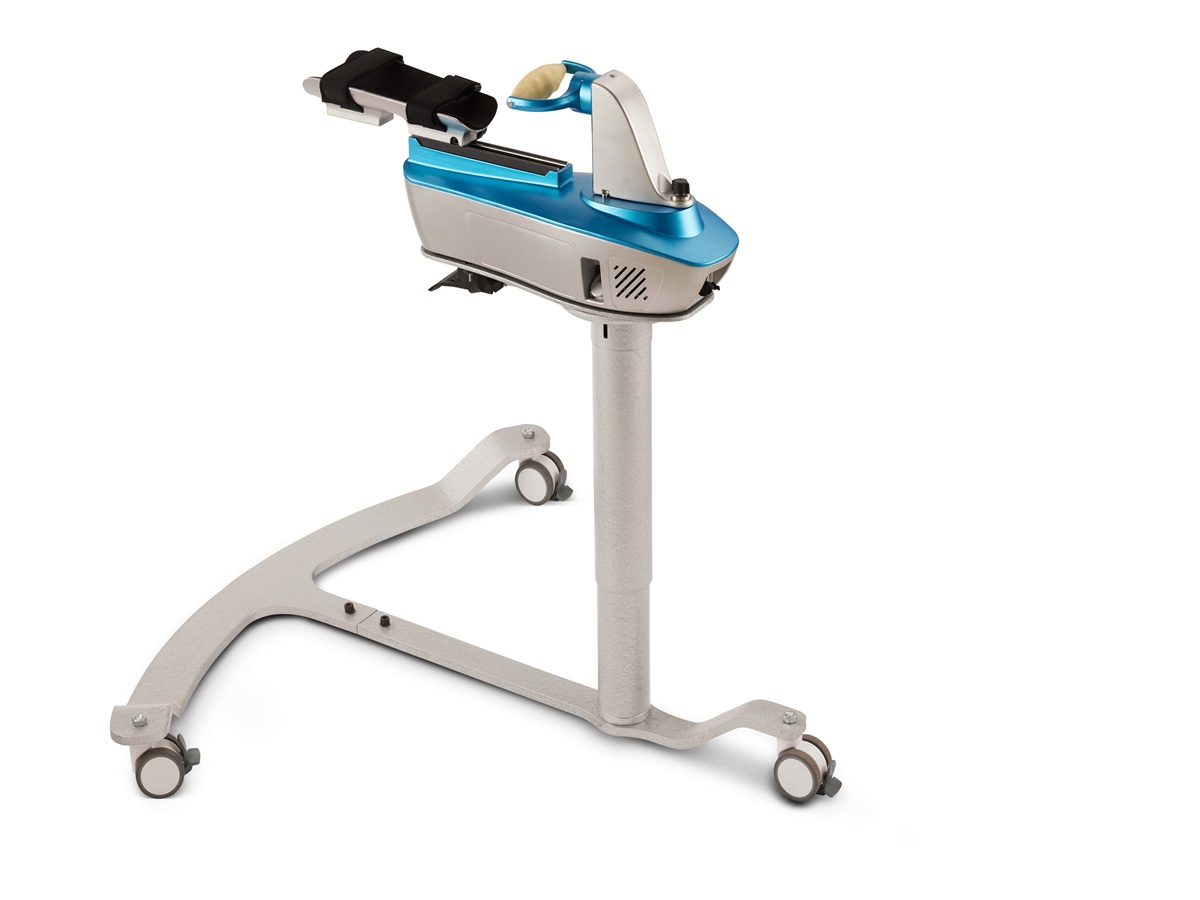
IIT Madras and CMC Vellore researchers have developed a cost-effective and portable plug-and-train robot for hand rehabilitation.
CMC is also known as Christian Medical College and is located in Vellore in Tamil Nadu.
 Pluto
Pluto
Called ‘PLUTO’ (Plug and Train Robot), this device technology was licensed through Technology Transfer Office-TTO ICSR and commercialized by Thryv Rehab Solutions.
It addresses a significant gap in the current rehabilitation market.
This innovative device is well-positioned to meet the growing demand for affordable and adaptable rehabilitation solutions in clinical and home settings.
Indigenous
PLUTO is also the first and only indigenous robot to have been tested in Indian homes, demonstrating that PLUTO can deliver intense therapy and make therapy accessible.
PLUTO has already benefitted more than 1,000 Patients in the last four years.
Research
This product is a great example of academic research successfully translating into a product that reached the common man and is poised to benefit thousands of patients.
Inventors
The device inventors are Prof. Sujatha Srinivasan (Principal Investigator), Department of Mechanical Engineering, IIT Madras, Dr. Aravind Nehrujee, (PhD Scholar) of Department of Mechanical Engineering, IIT Madras and Dept. of Bioengineering, CMC Vellore and Prof. Sivakumar Balasubramanian, Department of Bioengineering, CMC Vellore.
The Technology Transfer Office TTO– IPM Cell, in the Office of Industrial Consultancy and Sponsored Research (IC&SR), IIT Madras, facilitated the technology transfer and commercialization.
Offers
This patented technology offers precise therapeutic movements and real-time feedback, ensuring better outcomes for patients with conditions such as stroke, spinal cord injury, multiple sclerosis, Parkinsons’ disease and post hand-surgery, among others, say sources from IIT Madras.
 Usage
Usage
The device is well-suited for use in rehabilitation centres, clinics, hospitals, and even patients’ homes, bridging the gap in accessibility to effective, affordable hand rehabilitation solutions.
The innovation’s cost-effectiveness and portability make it a transformative tool in the healthcare industry, say sources from IIT Madras.
TTKCRRDD at IIT Madras
Prof. Sujatha Srinivasan, who is also the Head of TTK Center for Rehabilitation Research and Device Development at IIT Madras elaborated on the need for such affordable devices in assistive technologies.
Professor said PLUTO revolutionises hand rehabilitation by providing an affordable and accessible solution for patients with post-stroke conditions.
Its portability enables timely and consistent therapy at home or bedside, improving recovery outcomes and reducing dependency on caregivers, said Prof Sujatha of IIT Madras.
CMC Vellore
Prof. Sivakumar Balasubramanian, Department of Bioengineering, CMC Vellore, said as part of research and development by CMC Vellore and IIT Madras, PLUTO has been set up for routine clinical use across 11 different clinics across India.
Over 1,000 patients with hand impairments have used the device for therapy; at least 15 patients per week use PLUTO for routine hand therapy at CMC Vellore, he said.
PLUTO was also the first and only indigenous robot to have been tested in Indian homes, demonstrating that PLUTO can deliver intense therapy and make therapy accessible, he said.
Cost-effective
This cost-effective device minimises production costs while delivering high functionality, making advanced rehabilitation accessible to a broader audience.
Its affordability reduces financial strain on healthcare systems and patients, promoting widespread adoption, say sources from IIT Madras.
Design
The robot’s modular design uses recyclable materials and energy-efficient processes, reducing waste and environmental impact.
Its adaptability eliminates the need for multiple devices, supporting sustainable healthcare innovation, say sources from IIT Madras.
Therapy
Dr. Aravind Nehrujee, who developed PULTO over the course of his joint PhD with IIT Madras and CMC Vellore, said, in the present era, conventional rehabilitation robots for hand therapy are either complex and expensive systems capable of training multiple hand functions or simple and singular-function devices requiring multiple units for comprehensive therapy.
These systems lack portability and adaptability, making them unsuitable for bedside, wheelchair-based, and home-based use, he said.
The high cost, bulkiness, and lack of modularity limit their adoption in most Indian clinical settings and home-based rehabilitation, he said.
Hence, there is a need for an efficient and cost-effective solution, he said.
Rehabilitation
PLUTO is a modular, portable robot that facilitates advanced hand rehabilitation therapy with adaptive assistance and therapeutic gaming.
The device provides targeted therapy for wrist and hand movements using a single actuator and a set of interchangeable mechanical handles, say sources from IIT Madras.
The modular design ensures versatility, allowing training of various functions such as wrist flexion/extension, forearm pronation/supination, and hand opening-closing.
 Collaboration
Prof. Manu Santhanam, Dean (ICSR), IIT Madras, said the collaboration between IIT Madras and CMC Vellore will pave the way for many more interesting innovations with respect to assistive devices.
With technology commercialization and industry implementation being one of the key directives of IIT Madras, we will aim to work towards more such technology adaptations.
The highlights of PLUTO include
Ø A compact, portable design that allows bedside or wheelchair-based therapy, making it accessible for home or clinical use.
Ø A plug-and-train mechanism with various therapy tools for diverse hand functions, improving usability and flexibility.
Ø A gearless DC motor with a plug-in mechanism enables seamless connection and operation of therapy tools.
Ø High modularity and low-cost fabrication ensure adaptability and affordability for healthcare providers and patients.
Ø Scalability for mass production, supporting widespread adoption across clinical, rehabilitation, and home settings.
Ø A design that addresses early rehabilitation stages for conditions like stroke or hand paralysis, promoting faster functional improvement.
Also Read – IIT Madras launches great major initiatives
Next article
How to Apply for JEE Main 2027: Registration Process, Documents & more