

Introduction
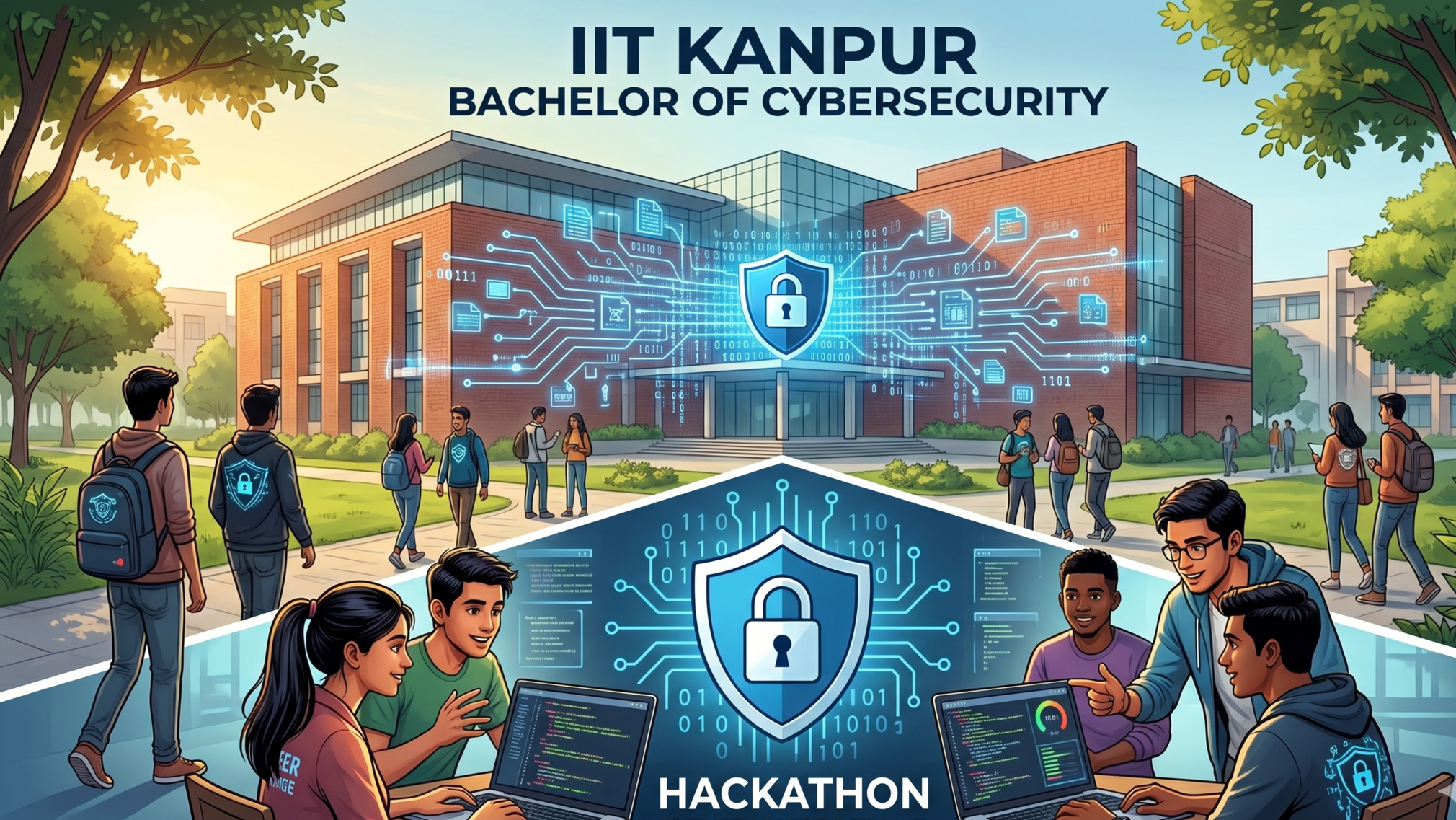
For years, getting into an IIT meant one thing: cracking JEE Advanced. That’s still true for most programmes. But IIT Kanpur just opened a completely different door for students who can hack, defend, and think like cybersecurity professionals — not just solve textbook problems.
On June 12, 2026, IIT Kanpur Director Professor Manindra Agrawal announced the launch of a new undergraduate-level cybersecurity programme, with admissions decided through a hackathon rather than a traditional entrance exam. The announcement came alongside the appointment of Nisarg Adhikari, a young cybersecurity researcher known for uncovering vulnerabilities in CBSE’s online system, as an engineer at the institute.
In this article, you’ll learn what this new IIT Kanpur Bachelor of Cybersecurity programme is about, who is eligible, how the hackathon-based admission process is expected to work, how to prepare for it, and what to watch for as official dates roll out.
Table of Contents
- What Is the New IIT Kanpur Cybersecurity Programme?
- Why a Hackathon Instead of an Entrance Exam?
- Eligibility Criteria (What We Know So Far)
- Programme Structure and Duration
- Important Dates and Timeline
- How to Prepare for a Cybersecurity Hackathon Admission
- Step-by-Step Preparation Roadmap
- Common Mistakes Aspirants Make
- Latest Trends in Cybersecurity Hiring and Education
- Key Takeaways
- Conclusion
- FAQs
What Is the New IIT Kanpur Cybersecurity Programme?
According to Professor Agrawal, the programme was created in direct response to a sharp rise in cyberattacks on India’s digital infrastructure. The director said admission to the programme will be offered through a hackathon-based selection process aimed at identifying students with proved cybersecurity skills and practical experience. ETV Bharat
This isn’t just a rebranded computer science elective. The programme will run for approximately two years, with an emphasis on hands-on training rather than purely theoretical learning, and institute experts will ensure that preference is given to students who are already involved in cybersecurity-related work or have shown aptitude in the field. ETV Bharat
In simple terms: IIT Kanpur isn’t looking for students who memorized network security definitions. It’s looking for students who have already broken into systems (ethically), built tools, or solved real CTF (Capture The Flag) challenges.
Why a Hackathon Instead of an Entrance Exam?
This idea has been brewing for over a year. Back in early 2025, IIT Kanpur’s leadership had already floated the concept. As reported by Careers360, admission to the BTech in intelligent systems will be based on JEE Advanced, but for the special cybersecurity programme, it will be a hackathon, with the proposal having received approval from all the academic bodies of the institute at the time. Careers360Careers360
By July 2025, the plan had moved further along. A new entrance through a hackathon was in development for the cybersecurity programme, already approved by the relevant academic councils and awaiting final authentication. careers360
The reasoning is straightforward and reflects a broader shift in tech education globally: in cybersecurity, real-world problem-solving under pressure is a far better predictor of capability than a written exam. A candidate who can find and patch a live vulnerability in a simulated environment within a few hours demonstrates exactly the skill set the field demands.
Eligibility Criteria (What We Know So Far)
As of this announcement, IIT Kanpur has not published a detailed, formal eligibility document specifically for this Bachelor of Cybersecurity programme. However, based on official statements and the pattern followed by IIT Kanpur’s existing hackathon — HACK IITK — we can outline what’s likely:
Likely Eligibility Pointers
- Academic background: Students who have completed or are completing Class 12 with Physics, Chemistry, and Mathematics (PCM), similar to standard IIT B.Tech eligibility norms.
- Demonstrated cybersecurity aptitude: Strong preference for students with prior exposure to CTF competitions, bug bounty programmes, ethical hacking certifications, or open-source security contributions.
- Selection through hackathon performance: Rather than a percentile or rank cutoff, selection appears focused on practical problem-solving demonstrated during the hackathon rounds.
- Open to a national pool: IIT Kanpur’s existing hackathons, such as HACK IITK, are national-level events targeting undergraduate and postgraduate students from across India, suggesting the admission hackathon will likely follow a similarly broad participation model. Education News
Important note for readers: Since the official policy document, application portal, and final eligibility criteria for this specific Bachelor of Cybersecurity admission route have not yet been published by IIT Kanpur, prospective applicants should treat the above as informed expectations, not confirmed rules. Always cross-check with the official IIT Kanpur website (iitk.ac.in) before making decisions.
Programme Structure and Duration
Here’s what’s been officially confirmed about the academic design:
- Duration: Approximately two years, focused on intensive cybersecurity training. ETV Bharat
- Teaching style: Hands-on training rather than purely theoretical learning — meaning labs, simulations, live-fire exercises, and red team/blue team scenarios over lecture-heavy modules. ETV Bharat
- Internships with national security agencies: Students will undergo intensive practical training during the initial two years and subsequently be offered internship opportunities with national security agencies, giving them exposure to emerging cyber risks, attack methods, and defensive strategies used to protect critical systems. ETV BharatETV Bharat
- Goal: To build a pool of highly capable “cyber warriors” who can contribute to strengthening India’s cybersecurity ecosystem. ETV Bharat
This structure mirrors how elite cybersecurity training works globally — short, intense, applied, with real institutional partnerships rather than years of generalized coursework.
Important Dates and Timeline
| Event | Status / Date |
|---|---|
| Programme announcement by IIT Kanpur Director | June 12, 2026 |
| Appointment of Nisarg Adhikari as engineer at IIT Kanpur | Announced June 12, 2026 |
| Initial academic approval (Education Policy Committee, Senate, Board of Governors) | Reported in progress through 2025 |
| Detailed hackathon admission criteria, dates, and portal | Not yet published — expected to follow IIT Kanpur’s standard admission cycle announcements |
| Related event – HACK IITK 2026 (a separate annual national cybersecurity hackathon by C3iHub, IIT Kanpur) | Registration deadline extended to 10 January 2026, IIT Kanpur with the final round scheduled for March 2026 at IIT Kanpur campus IIT Kanpur |
A quick clarification: HACK IITK 2026 is C3iHub’s annual national cybersecurity hackathon (a separate, ongoing event with its own prize pool and tracks). It is not confirmed to be the same as the admission hackathon for the new Bachelor of Cybersecurity programme, though it shows the kind of format, scale, and rigor IIT Kanpur is capable of running. Future cohorts of this hackathon — or a dedicated admission-specific version — could realistically serve as the selection event.
Aspirants should bookmark iitk.ac.in and the C3iHub portal (c3ihub.iitk.ac.in) and check both regularly for formal updates.
How to Prepare for a Cybersecurity Hackathon Admission
If selection truly hinges on hackathon performance, your preparation strategy needs to look very different from typical JEE prep. Here’s where to focus your energy.
1. Build a Strong CTF (Capture The Flag) Foundation
CTF challenges are the backbone of most cybersecurity hackathons. They test skills across:
- Web exploitation – SQL injection, XSS, authentication bypasses
- Cryptography – breaking weak encryption, decoding ciphers
- Reverse engineering – analyzing binaries and understanding compiled code
- Forensics – extracting hidden information from files, memory dumps, or network traffic
- Network security – packet analysis, exploiting misconfigured services
Practical tip: Start with beginner-friendly platforms like picoCTF, TryHackMe, and Hack The Box. Spend at least 3-6 months building consistent practice before a major event.
2. Learn Linux and Command-Line Tools Inside Out
Almost every cybersecurity tool — Wireshark, Nmap, Burp Suite, Metasploit — runs best on Linux. Comfort with the terminal isn’t optional; it’s foundational.
3. Understand Networking Fundamentals
You can’t defend or attack a system you don’t understand. Get solid on:
- TCP/IP, DNS, HTTP/HTTPS
- Firewalls, VPNs, and how data moves across networks
- Common attack vectors (DDoS, man-in-the-middle, phishing)
4. Get Comfortable with at Least One Programming Language
Python is the go-to for scripting exploits and automating tasks. Many CTF write-ups and tools are Python-based, making it the highest-value language for beginners in this space.
5. Practice Team-Based Problem Solving
Most hackathons are team events. Selection committees often look at how well you communicate under pressure, divide tasks, and present solutions — not just raw technical skill.
Step-by-Step Preparation Roadmap
- Months 1-2: Learn networking basics, Linux fundamentals, and Python scripting.
- Months 3-4: Start solving beginner CTF challenges on picoCTF and TryHackMe. Focus on understanding why an exploit works, not just copying solutions.
- Months 5-6: Join intermediate CTFs (Hack The Box machines, local college hackathons). Build a portfolio — a GitHub profile with write-ups of challenges you’ve solved.
- Months 7-8: Participate in at least one live national hackathon (such as HACK IITK or similar events) to get used to time pressure and team dynamics.
- Ongoing: Follow cybersecurity news, vulnerability disclosures, and tools. Read write-ups from top CTF teams to understand advanced techniques.
Common Mistakes Aspirants Make
- Treating it like a coding exam: Hackathon-based admission rewards creative, exploratory thinking — not memorized algorithms.
- Ignoring the basics: Jumping straight to advanced exploits without understanding networking or operating system fundamentals leads to shallow knowledge that falls apart under real challenges.
- Solo preparation only: Since hackathons are team-based, never having worked in a team is a major disadvantage. Join or form a small CTF team early.
- Not documenting your work: A documented track record — write-ups, GitHub repos, certifications — builds credibility and may matter during evaluation.
- Waiting for “official confirmation” to start preparing: By the time formal dates are announced, students who started early will have a significant head start. Cybersecurity skills take months to build properly.
Latest Trends in Cybersecurity Hiring and Education
This launch fits a broader pattern playing out across India and globally:
- Skills-first hiring is replacing degree-first hiring in cybersecurity, with companies and government agencies increasingly valuing demonstrated ability (bug bounties, CTF rankings, certifications) over GPA alone.
- National security agencies are partnering with academic institutions to build talent pipelines directly — the internship component of this programme reflects that.
- India’s digital infrastructure expansion (UPI, Aadhaar-linked services, smart city projects) has dramatically increased the attack surface, driving urgent demand for trained defenders.
- Young independent researchers are being absorbed into formal institutions — exactly what’s happening with Nisarg Adhikari’s appointment, signaling that informal, self-taught expertise is now a legitimate entry point into elite institutions.
Key Takeaways
- IIT Kanpur has launched a new undergraduate cybersecurity programme with admission decided through a hackathon, not a traditional entrance exam.
- The programme runs for roughly two years, emphasizing hands-on training and internships with national security agencies.
- Formal eligibility criteria, application dates, and the admission hackathon’s exact format have not yet been officially published — check iitk.ac.in regularly.
- Preparation should focus on CTF practice, Linux, networking, Python, and team-based problem solving — not rote exam prep.
- This move reflects a larger shift toward skills-based admissions and hiring in India’s tech and security sectors.
Conclusion
IIT Kanpur’s new Bachelor of Cybersecurity programme represents a genuinely different way into one of India’s most prestigious institutions — one built around what you can do, not just what you can recall under exam conditions. While the official dates, eligibility documents, and application portal are still pending, the direction is clear: students with real, demonstrable cybersecurity skills now have a credible, hands-on pathway to an IIT.
If this interests you, the smartest move is to start building your skills today — through CTFs, networking fundamentals, and hands-on labs — so that whenever the official hackathon details drop, you’re not starting from zero.
FAQs
1. Has IIT Kanpur officially announced dates for the cybersecurity hackathon admission?
Not yet. As of the June 12, 2026 announcement, the programme has been launched, but detailed admission dates and the hackathon format haven’t been published. Check iitk.ac.in for updates.
2. Is the IIT Kanpur Bachelor of Cybersecurity programme separate from JEE Advanced admissions?
Yes. This programme uses a hackathon-based selection process, separate from the JEE Advanced route used for most B.Tech programmes at IIT Kanpur.
3. How long is the IIT Kanpur cybersecurity programme?
The programme runs for approximately two years, focused on intensive, hands-on cybersecurity training followed by internship opportunities.
4. What kind of skills should I learn to prepare for a cybersecurity hackathon?
Focus on CTF challenges, Linux fundamentals, networking concepts, Python scripting, and basic penetration testing tools like Nmap and Wireshark.
5. Who is Nisarg Adhikari and why is he relevant to this announcement?
Nisarg Adhikari is a young cybersecurity researcher known for identifying vulnerabilities in CBSE’s online system. He was appointed as an engineer at IIT Kanpur alongside the programme’s announcement, reflecting the institute’s focus on practical talent.
6. Will students get government or security agency internships through this programme?
According to IIT Kanpur’s director, students will be offered internship opportunities with national security agencies after their initial training period.
7. Is HACK IITK the same as the admission hackathon for this programme?
Not confirmed. HACK IITK is C3iHub’s existing annual national cybersecurity hackathon, separate from this new admission process — though it may give a sense of the format and scale future admission hackathons could follow.
Click here:https://www.collegechalo.com/news-panel/ignou-phd-admission-2026-is-open/
Next article
NSUT Admission 2026 guide eligibility, JEE Main entrance details, JAC Delhi counselling dates, selection process, cutoffs & documents