

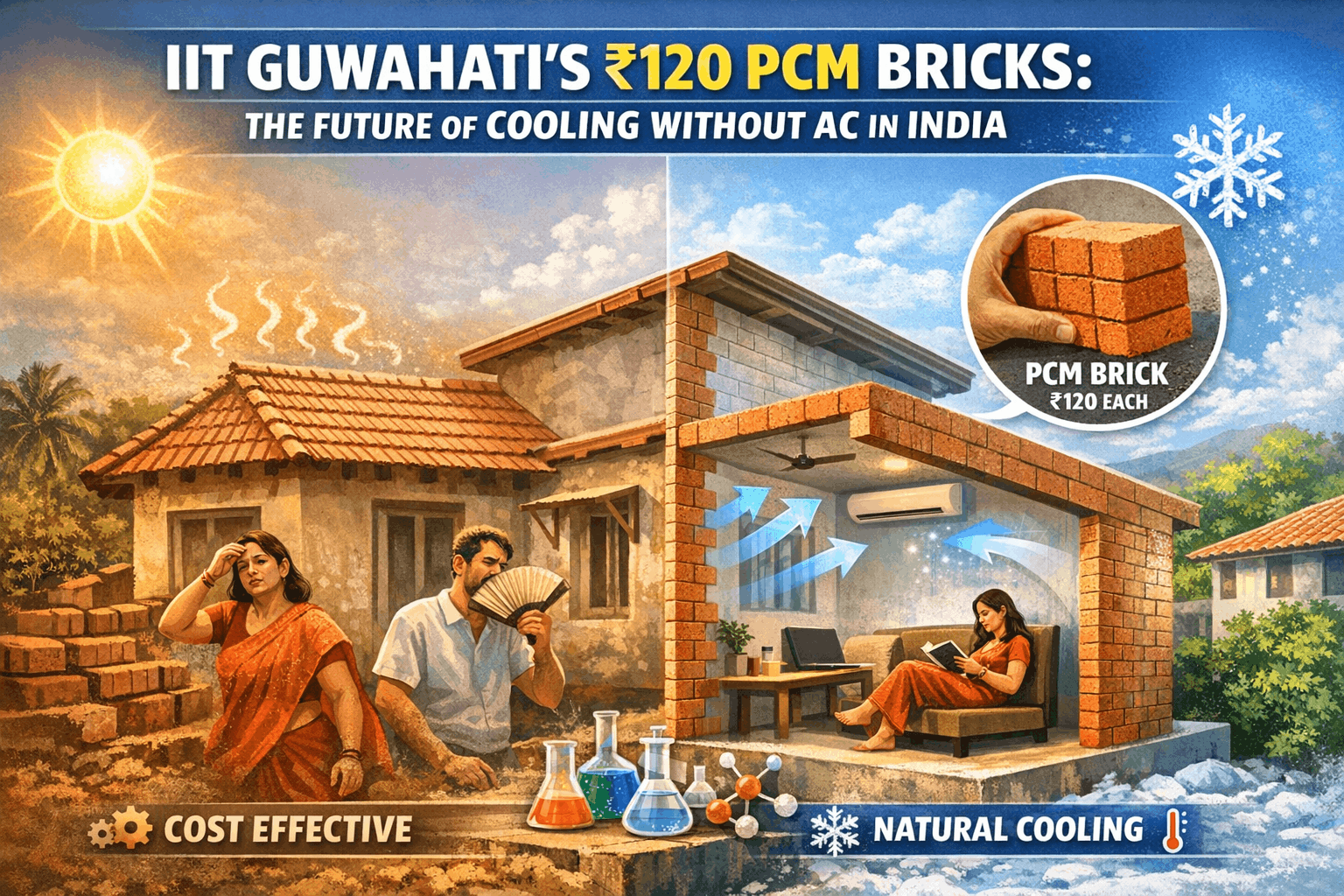
Introduction: A Cooling Revolution from IIT Guwahati
Author – Ritesh Ranjan: As India battles rising temperatures and intense heatwaves, a groundbreaking innovation from Indian Institute of Technology Guwahati is offering a smarter, sustainable alternative to air conditioning. Researchers have developed PCM (Phase Change Material) embedded bricks priced at just ₹115–130, capable of naturally cooling buildings and reducing dependence on ACs.
Published in the Journal of Energy Storage, this innovation led by Pankaj Kalita and his team promises to reduce indoor temperatures by up to 3°C while cutting electricity bills by 10–20%.
The Cooling Crisis in India
India’s cooling demand is skyrocketing. According to the Bureau of Energy Efficiency, nearly 50% of electricity consumption in buildings is used for cooling. This contributes to over 300 million tonnes of CO₂ emissions annually.
Urban areas, especially cities like Delhi and Mumbai, experience extreme heat due to dense construction and poor insulation. Traditional bricks fail to prevent heat from entering buildings, forcing heavy reliance on air conditioners.
What Are PCM Bricks and How Do They Work?
The IIT Guwahati innovation combines Autoclaved Aerated Concrete (AAC) with Phase Change Materials (PCMs) and biochar to create a highly efficient cooling brick.
How It Works:
- PCMs absorb heat during the day by melting at around 35°C
- This process stores heat energy instead of letting it pass indoors
- At night, the material solidifies and releases the stored heat
This cycle ensures stable indoor temperatures throughout the day, reducing the need for artificial cooling.
The Science Behind the Innovation
The team identified OM35 PCM as the most suitable material for Indian climatic conditions (28–38°C range). Millions of micro-droplets of PCM are embedded within the brick structure, enabling efficient heat absorption.
Biochar—derived from agricultural waste—plays a critical role:
- Prevents leakage of PCM
- Enhances thermal conductivity
- Makes the system eco-friendly
AAC bricks further enhance performance:
- 80% lighter than traditional clay bricks
- Fire-resistant and earthquake-safe
- Better insulation properties
Real-World Impact: Cooler Homes, Lower Bills
Simulation studies show that PCM bricks can:
- Reduce wall temperatures by up to 3°C
- Lower indoor temperatures significantly
- Cut cooling energy consumption by 10–20%
For an average Indian household, this could mean savings of ₹5,000 per year on electricity bills.
Comparison: PCM Bricks vs Traditional Bricks
| Feature | Conventional Bricks | IITG PCM Bricks |
| Heat Control | Poor | Excellent |
| Energy Savings | None | 10–20% |
| Indoor Comfort | Fluctuates | Stable |
| Sustainability | Low | High |
Why India Needs This Now
India faces increasing urban heat islands, with over 70% of cities affected, according to the Ministry of Housing and Urban Affairs.
PCM bricks align with national initiatives like:
- Perform Achieve and Trade Scheme
- PM Gati Shakti
They also support India’s goal of achieving net-zero emissions by 2070 and boosting the green building market.
Cost vs Benefit: Is It Worth It?
At ₹115–130 per brick, PCM bricks are significantly more expensive than traditional clay bricks (~₹8). However, the payback period is just around 2 years due to energy savings.
Long-Term Benefits:
- Lower electricity bills
- Reduced carbon footprint
- Improved indoor comfort
- Increased property value
As production scales, costs are expected to decrease further.
Startup Potential and Future Scope
The innovation is being commercialized by researchers including PMRF scholars Bitupan Das and Urbashi Bordoloi. With patents underway and pilot projects planned with government agencies, PCM bricks could soon enter mainstream construction.
India’s green building market, valued at over ₹1 lakh crore, offers a massive opportunity for adoption.
Challenges and Next Steps
While promising, the technology is still in the lab-to-field transition phase. Key challenges include:
- Large-scale manufacturing
- Market adoption
- Awareness among builders
Field trials in diverse climates—from humid Assam to dry Rajasthan—will be crucial.
Conclusion: A Cooler, Smarter Future
IIT Guwahati’s PCM bricks represent a game-changing innovation in sustainable construction. By combining affordability, efficiency, and eco-friendliness, they offer a practical solution to India’s growing cooling crisis.
As heatwaves intensify and energy demand rises, such innovations could redefine how India builds its cities—making them cooler, greener, and more resilient.
FAQs
1. What are PCM bricks?
PCM bricks are construction materials embedded with Phase Change Materials that absorb and release heat to maintain stable indoor temperatures.
2. How much can PCM bricks reduce temperature?
They can reduce wall temperatures by up to 3°C, improving indoor comfort significantly.
3. Are PCM bricks expensive?
Yes, they cost ₹115–130 per brick, but the investment pays back within 2 years through energy savings.
4. Can PCM bricks replace air conditioners?
They reduce the need for ACs but may not completely replace them in extreme conditions.
5. Are PCM bricks eco-friendly?
Yes, they use biochar from agricultural waste and help reduce carbon emissions, making them a sustainable building solution.
Next article
NSUT Admission 2026 guide eligibility, JEE Main entrance details, JAC Delhi counselling dates, selection process, cutoffs & documents