

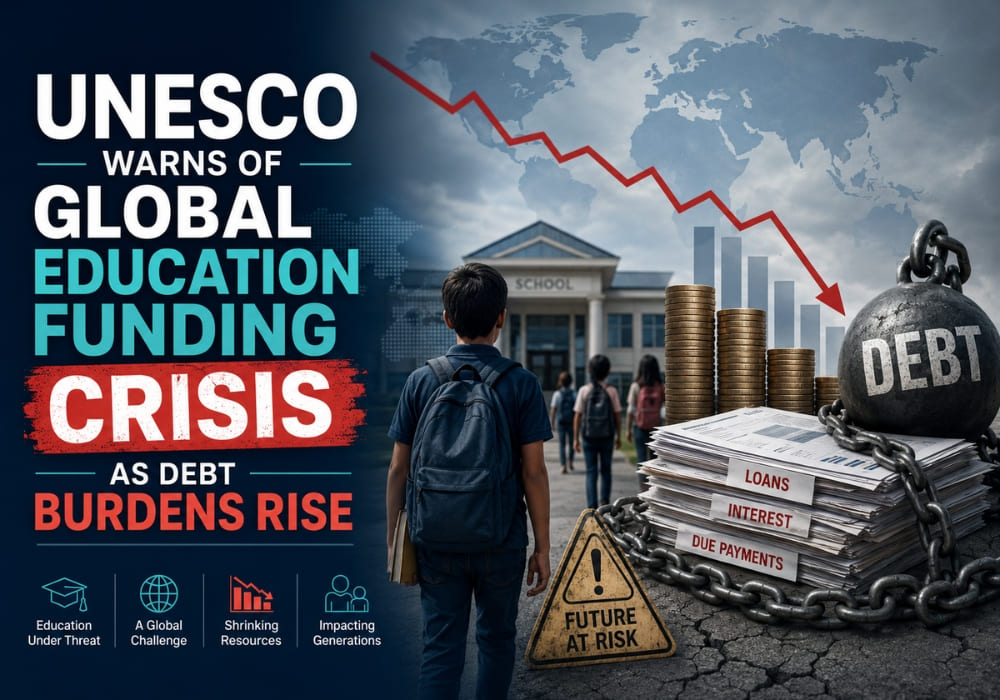
Author – Ritesh Ranjan: systems around the world are facing a serious financing crisis. According to new data released by UNESCO, international aid for education is declining while a growing number of countries are spending more on debt repayments than on schools, teachers and learning programmes.
Marking TES+4, four years after the Transforming Education Summit, UNESCO warned that aid to education could fall by as much as 30% between 2023 and 2027. At the same time, 113 countries are now spending more on debt servicing than on education.
The warning highlights a widening gap between global education commitments and the financial resources available to achieve them. Without urgent action, UNESCO says millions of learners could face overcrowded classrooms, teacher shortages, reduced access to learning materials and fewer opportunities to complete their education.
International Aid to Education Is Falling
New research from UNESCO’s Global Education Monitoring Report shows that international aid to education declined by 8% in 2024 compared with the previous year.
The situation is even more concerning for basic education. Aid for pre-primary, primary and lower-secondary education fell by 15%. These levels of education form the foundation of a child’s learning journey, making the decline particularly damaging for younger students and disadvantaged communities.
UNESCO projects that low- and lower-middle-income countries have already lost more than one-fifth of the education aid they received in 2023. Some countries have experienced much steeper reductions. Afghanistan, Liberia, Mali and Niger have reportedly faced losses of more than 40%.
Education is also receiving a smaller share of overall development assistance. In 2024, education accounted for only 7.5% of total development aid, its lowest level in approximately two decades.
This decline comes at a time when education systems require additional investment rather than spending cuts. Many countries are still trying to address learning losses, improve digital access, recruit qualified teachers and support children affected by poverty, conflict and displacement.
Debt Repayments Are Crowding Out Education Spending
The education financing crisis is closely connected to rising national debt burdens.
UNESCO’s Debt and Education package reveals that 113 countries, representing around 6.1 billion people, spend more on debt servicing than on education. In low-income countries, spending on debt repayments is nearly four times higher than public spending on education.
When governments are required to allocate a large share of their budgets to debt repayments, less funding remains for schools and other essential public services. Education ministries may be forced to delay infrastructure projects, freeze teacher recruitment, reduce learning support programmes or cut spending on textbooks and technology.
These decisions may provide short-term budget relief, but they can create serious long-term consequences.
Lower investment in education can lead to weaker learning outcomes, reduced workforce productivity and slower economic growth. It can also increase inequality because students from low-income families often depend most heavily on publicly funded schools.
UNESCO argues that education should not be treated merely as a government expense. It is a long-term investment in economic development, social stability, public health and national resilience.
Climate Change, Conflict and Inflation Add Pressure
Falling aid and rising debt are not the only challenges affecting education systems.
Schools around the world are also dealing with climate-related disasters, armed conflict, inflation, migration and growing social inequality. Floods, heatwaves, storms and droughts can damage school buildings, disrupt transportation and force students to leave their communities.
Conflict can close schools for months or even years, placing children at greater risk of displacement, child labour and early marriage. Meanwhile, inflation increases the cost of school construction, electricity, transportation, meals, teaching materials and staff salaries.
Low- and lower-middle-income countries are especially vulnerable because they often have limited financial resources to respond to several crises at the same time.
Without reliable funding, education systems may struggle to recover from emergencies while also meeting their everyday responsibilities.
Can Debt-for-Education Swaps Help?
To address the crisis, UNESCO is encouraging countries to consider debt-for-education swaps.
A debt-for-education swap is an agreement in which part of a country’s external debt is cancelled, reduced or restructured in exchange for a commitment to invest an agreed amount in education.
Instead of sending the full repayment to an international creditor, the debtor country directs part of the money towards projects such as school construction, teacher development, student nutrition, digital learning or basic education services.
UNESCO has released a technical guide to help creditor and debtor countries design and implement these agreements more effectively. The organisation believes such swaps can create additional fiscal space while protecting education budgets.
Several countries have already used this financing model.
In Côte d’Ivoire, a 2023 agreement with France supported the construction of more than 30 schools in underserved communities and benefited approximately 30,000 students.
In Egypt, a €29 million debt swap with Germany helped fund school feeding, nutrition initiatives and basic services.
In Peru, a programme involving Spain supported 50 education projects across eight vulnerable regions.
These examples show that debt swaps can deliver measurable benefits when agreements are transparent, properly monitored and connected to national education priorities.
However, debt swaps alone cannot solve the global financing crisis. They must be supported by responsible lending, sustainable debt management, stronger domestic revenue systems and continued international assistance.
What TES+4 Means for Global Education
TES+4 marks four years since the Transforming Education Summit, which was organised to encourage governments and international partners to make education a higher political priority.
The TES+4 discussions brought together political leaders, ministers, civil society groups, young people, academics and private-sector representatives. Participants included South African President Cyril Ramaphosa and United Nations Deputy Secretary-General Amina J. Mohammed.
The meeting examined education financing as well as the influence of artificial intelligence, climate change, resilience and technological transformation on the future of learning.
TES+4 also served as an important checkpoint ahead of the 2030 deadline for Sustainable Development Goal 4.
SDG 4 aims to ensure inclusive and equitable quality education and promote lifelong learning opportunities for all. However, declining financial support could make this goal increasingly difficult to achieve.
With only a few years remaining until 2030, UNESCO has stressed that the next phase will be critical. Governments will need to protect education spending, improve financial efficiency and prioritise learners who are most at risk of being left behind.
What Governments and Development Partners Must Do
Addressing the crisis will require coordinated action at both national and international levels.
Governments must protect education budgets even during periods of economic pressure. They should also improve tax collection, reduce financial leakages and ensure that education funds reach schools and communities where they are needed most.
International donors must prevent further reductions in education aid, particularly for basic education and emergency learning programmes. Multilateral institutions and creditor countries should also expand debt restructuring and debt-swap options for countries facing unsustainable repayment pressures.
At the same time, education spending must become more effective. Funding should be directed towards qualified teachers, safe classrooms, foundational learning, inclusive education, digital access and support for vulnerable students.
Transparent reporting will also be essential. Communities should be able to see how education funds are allocated and whether programmes are improving learning outcomes.
The Cost of Inaction
The global education financing crisis is not only a problem for schools. It is a major economic and social risk.
Children who do not receive quality education may face limited employment opportunities and lower lifetime earnings. Countries with weak education systems may struggle to build skilled workforces, adopt new technologies and compete in the global economy.
Education also plays an important role in reducing poverty, improving health, supporting gender equality and strengthening democratic participation.
UNESCO’s message is therefore urgent: cutting education investment may reduce spending today, but it creates much larger costs in the future.
The world still has an opportunity to protect schools and learners. Debt-for-education swaps, stronger international cooperation, sustainable financing and political commitment can help countries move forward.
However, action must begin before declining aid and rising debt push global education goals further out of reach.
Frequently Asked Questions
1. What is causing the global education funding crisis?
The crisis is being driven by declining international aid, rising government debt repayments, inflation, conflict, climate-related emergencies and pressure on national budgets. Many low-income countries do not have enough resources to manage these challenges while maintaining adequate education spending.
2. How much did international education aid decline in 2024?
According to UNESCO data, international aid to education declined by 8% in 2024. Aid for basic education, including pre-primary, primary and lower-secondary education, fell by 15%.
3. What is a debt-for-education swap?
A debt-for-education swap is an agreement that converts part of a country’s external debt into domestic investment in education. The government redirects agreed funds towards education projects instead of using the entire amount for debt repayment.
4. How many countries spend more on debt than education?
UNESCO reports that 113 countries, representing approximately 6.1 billion people, spend more on debt servicing than on education. The problem is particularly severe in low-income countries.
5. What is Sustainable Development Goal 4?
Sustainable Development Goal 4 is the United Nations goal to ensure inclusive and equitable quality education and promote lifelong learning opportunities for everyone by 2030.
Next article
NSUT Admission 2026 guide eligibility, JEE Main entrance details, JAC Delhi counselling dates, selection process, cutoffs & documents