

Introduction
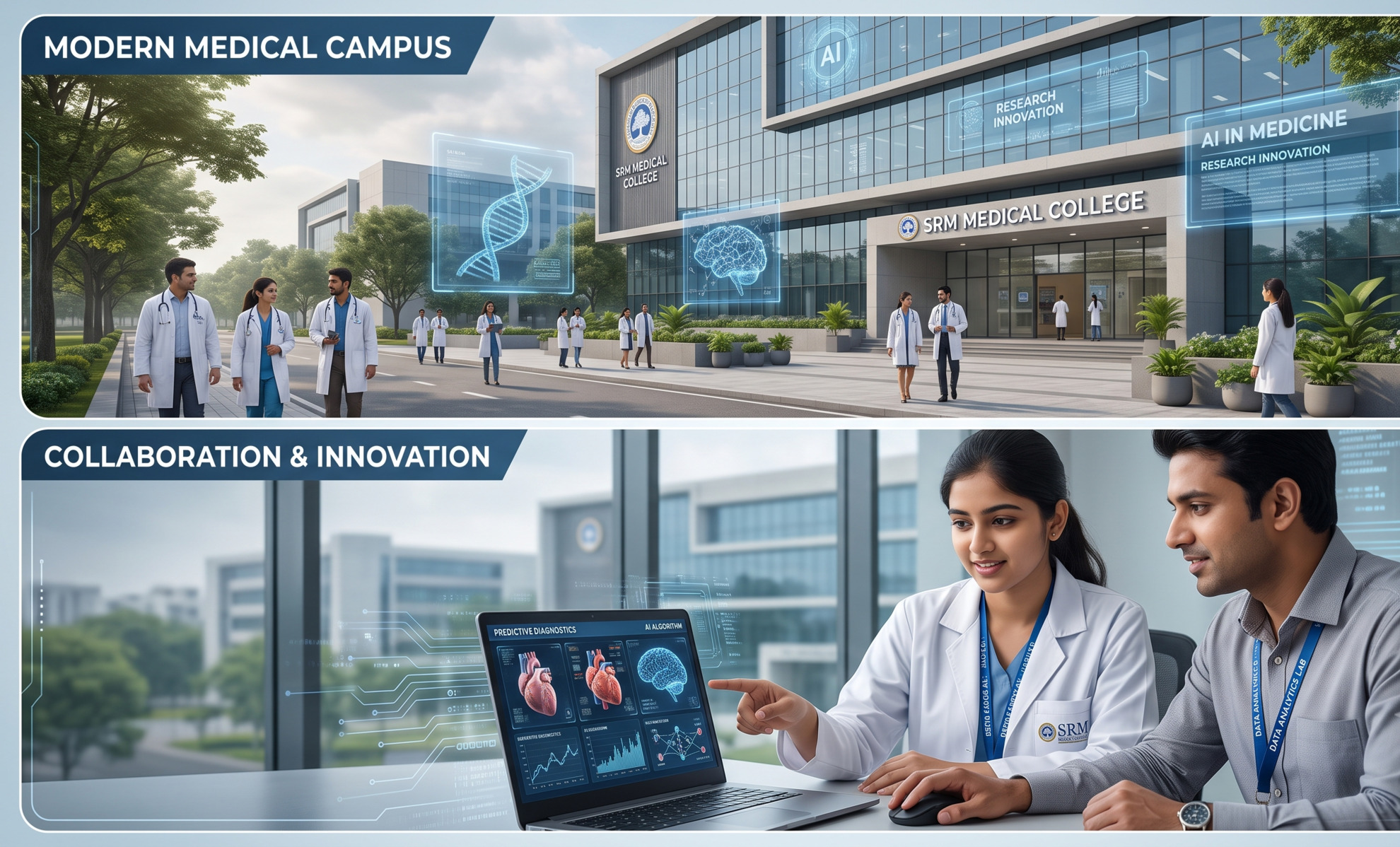
Medicine is changing faster than most people realise. AI-assisted diagnostics, data-driven treatment planning, and interdisciplinary research are no longer buzzwords in top medical schools — they’re becoming part of the core curriculum. SRM Medical College Hospital and Research Centre, one of India’s leading deemed-university medical institutions, is positioning itself at the front of this shift, blending traditional clinical training with artificial intelligence, technology exposure, and cross-department collaboration.
If you’re a NEET aspirant or a parent researching this college for 2026 admissions, this guide covers everything you need: how SRM is integrating AI into medical education, MBBS eligibility criteria, important dates, NEET cutoff expectations, and a practical preparation roadmap.
Table of Contents
- Why SRM Medical College Is Betting on AI
- How Interdisciplinary Learning Works at SRM
- SRM Medical College MBBS: Quick Overview
- Eligibility Criteria for 2026 Admission
- Important Dates You Cannot Miss
- Step-by-Step Admission Process
- NEET Cutoff Trends (What to Expect)
- Preparation Tips for Aspirants
- Common Mistakes to Avoid
- Latest Trends in AI-Driven Medical Education
- Key Takeaways
- FAQs
Why SRM Medical College Is Betting on AI
SRM Institute of Science and Technology (SRMIST) has invested heavily in AI infrastructure across its campuses, and medical education is a direct beneficiary of this push. The university operates a dedicated Centre for AI in Health Science, which brings together medical faculty, technology mentors, and data science experts to build AI-driven solutions for diagnostics, treatment planning, and healthcare management. SRM Institute of Science & Technology
This isn’t a side project. SRM has also set up a broader Centre for AI powered by an NVIDIA DGX A100 supercomputing platform, which supports interdisciplinary projects spanning healthcare, engineering, and social sciences while giving students hands-on experience with real-world AI infrastructure. SRM Institute of Science & Technology
For an MBBS student, this translates into practical exposure to:
- AI-assisted diagnostic imaging and pattern recognition
- Predictive analytics for patient outcomes
- Data science tools applied to clinical research
- Cross-disciplinary projects with engineering and computer science departments
Why this matters for future doctors
Global healthcare is shifting toward precision medicine, where diagnosis and treatment plans are increasingly informed by large datasets and machine learning models. A medical graduate who understands how these tools work — not just how to use a stethoscope — has a real edge in postgraduate research, specialisation, and international opportunities.
How Interdisciplinary Learning Works at SRM
SRM markets itself as one of India’s largest multidisciplinary institutions. According to the college, SRM caters to over 45,000 students across 8 campuses in 5 states and offers more than 300 programs spanning engineering, medicine, dentistry, health sciences, science, humanities, management, law, agriculture, and hotel management. SRMIST
This scale is exactly what makes interdisciplinary learning practical rather than theoretical. Medical students on the Kattankulathur campus share infrastructure and research opportunities with engineering and data science departments — something a standalone medical college simply cannot offer.
The flagship medical campus itself is substantial: it sits on a 250+ acre campus, a 30-minute drive from Chennai, hosting students from across India and over 95 countries. SRMIST
What “tech-savvy, research-driven” actually looks like on the ground
- Joint projects between MBBS students and AI/CS departments on health-tech problems
- Access to simulation labs (SRM runs a simulation centre built in association with Harvard University)
- Research mentorship combining clinical faculty with data scientists
- Exposure to a large hospital ecosystem for real patient data-driven learning
SRM Medical College MBBS: Quick Overview
| Detail | Information |
|---|---|
| Course | MBBS |
| Duration | 4.5 years + 1 year compulsory internship |
| Total Seats | 250 (Kattankulathur campus) |
| Approval | National Medical Commission (NMC) |
| Admission Basis | NEET UG score + MCC/State counselling |
| Campus | SRM Nagar, Potheri, Kattankulathur, Chengalpattu, Tamil Nadu |
| Hospital | 1,500+ bed teaching hospital with 30+ departments |
The college is a constituent unit of SRM Institute of Science and Technology, a deemed-to-be university, meaning admissions run through centralized counselling rather than a separate entrance test.
Eligibility Criteria for 2026 Admission
Before applying, make sure you meet these core requirements:
Academic eligibility
- Class 12 (10+2) pass with Physics, Chemistry, and Biology/Biotechnology as compulsory subjects, from a recognized board
- Minimum 50% aggregate marks in PCB for General category candidates; 40% for SC/ST/OBC categories
Age criteria
- Minimum age: 17 years, as on a specified cut-off date in the admission year
- No upper age limit, following the Supreme Court’s 2018 ruling that removed age caps for NEET and MBBS admission
Entrance exam
- A valid, qualifying NEET UG 2026 scorecard is mandatory — there is no separate SRM entrance test for MBBS
Category eligibility
- Open to Indian nationals, NRIs, OCIs, and foreign nationals, though each category follows different quota rules and fee structures
Class 12 appearing students
- Students currently in Class 12 can appear for NEET UG and seek provisional admission, subject to meeting eligibility once board results are declared
Important Dates You Cannot Miss
NEET UG timelines drive the entire admission calendar for SRM Medical College, so tracking NTA and MCC announcements closely is essential. Based on the current 2026 cycle:
- NEET UG 2026 Re-Exam: Held on June 21, 2026, with admit cards released on June 14, 2026
- Re-NEET UG 2026 Result: Tentatively expected around July 20, 2026, for MBBS, BDS, and other UG programmes
- NEET PG 2026 Registration: Currently open, with the last date to apply around July 21, 2026 (relevant if you’re also tracking PG timelines)
- MCC AIQ Counselling: Typically begins in August, following result declaration
- Choice Filling: Candidates must register on the MCC portal (mcc.nic.in) and lock SRM Medical College as a preference during choice filling
- Counselling Rounds: Expect 4–5 rounds (Round 1, Round 2, and Mop-Up), with seats filled on a rolling, first-come-first-served basis in later rounds
Important note: Dates for NEET and counselling shift year to year and can change with little notice. Always cross-check the live schedule on neet.nta.nic.in and mcc.nic.in before making decisions, since third-party sites (including this one) can lag behind official updates.
Step-by-Step Admission Process
- Register and appear for NEET UG 2026 through the National Testing Agency
- Check your result and scorecard once declared by NTA
- Register on the MCC portal (mcc.nic.in) for All India Quota / Deemed University counselling
- Fill choices, selecting SRM Medical College Hospital & Research Centre and your preferred course
- Track seat allotment results after each round
- Report to the college with required documents if allotted a seat:
- NEET scorecard
- Class 10 and 12 mark sheets and certificates
- Online counselling registration certificate
- Category/domicile certificates (if applicable)
- Passport-size photographs
- Bond affidavit (for certain quota categories)
- Pay the registration and tuition fees to confirm your seat
- Participate in subsequent rounds (Round 2, Mop-Up) if you wish to improve your allotment — remember, each round is a fresh allocation, so don’t assume Round 1 is your only shot
NEET Cutoff Trends (What to Expect)
Cutoffs vary significantly by round, category, and quota. Based on recent trends:
| Category | Expected NEET Score Range (2026) |
|---|---|
| General | 550–580 |
| OBC | 500–540 |
| SC | 420–460 |
| ST | 390–430 |
| Management Quota (General) | 450+ |
| NRI Quota | 450+ |
For context, in the 2025 cycle, the General category cutoff score at SRM Kattankulathur in Round 1 counselling was 282 (on the raw NEET score scale), while the General AI quota last-round closing rank for MBBS was recorded at 732,623 — a reminder that closing ranks can extend quite far, especially in later rounds and under the Management/NRI quota
Takeaway: Don’t self-eliminate based on a moderate NEET score. Because SRM fills seats across multiple rounds and quota types, candidates with mid-range scores still have realistic chances, particularly in Round 2 and Mop-Up rounds.
Preparation Tips for Aspirants
For NEET preparation
- Build a strong NCERT-first foundation in Biology (highest weightage), followed by Chemistry and Physics
- Practice previous years’ NEET papers under timed conditions to build exam stamina
- Focus on high-yield topics: Human Physiology, Genetics, Ecology, Organic Chemistry reactions, and Mechanics
For counselling strategy
- Register for MCC counselling immediately after results — delays can cost you a round
- Research multiple colleges and rank your choices realistically instead of over-optimistically
- Keep all documents scanned and ready in advance; last-minute document issues cause missed rounds
For life at SRM specifically
- If AI and research genuinely interest you, ask about elective research rotations or interdisciplinary project opportunities during your campus visit or interaction with current students
- Visit the official SRM Medical College website and admissions office directly for the latest fee structure, since fees are revised periodically and vary by quota
Common Mistakes to Avoid
- Waiting too long to register for counselling after NEET results — early registration protects your options
- Ignoring Mop-Up rounds — many students give up after Round 1, missing seats that open up later as others leave for different colleges
- Relying only on unofficial cutoff predictors — always verify with MCC’s official cutoff data before finalising decisions
- Overlooking the total cost of attendance — tuition is only part of the picture; hostel fees, registration fees, and other charges add up significantly over the 5.5-year duration
- Assuming NRI/Management quota guarantees flexibility on NEET qualification — a valid NEET UG qualifying score is still mandatory across all quotas
Latest Trends in AI-Driven Medical Education
Medical education globally is moving toward:
- AI-integrated diagnostics training, where students learn to interpret AI-assisted imaging alongside traditional radiology
- Interdisciplinary curriculum integration, blending medical engineering, data science, and clinical training — a model being actively studied and implemented at institutions internationally
- Simulation-based learning, reducing dependency on live patient exposure during early training stages
- Research-first pedagogy, where undergraduate students are encouraged to publish or contribute to research projects rather than treating research as a postgraduate-only pursuit
SRM’s investment in centres focused specifically on AI in health science reflects this broader shift, aiming to produce graduates who are comfortable working alongside — not just apart from — emerging medical technology.
Key Takeaways
- SRM Medical College is actively integrating AI and interdisciplinary learning through dedicated centres and cross-department collaboration
- Admission is 100% NEET UG-based; there’s no separate SRM entrance exam for MBBS
- Total intake is 250 MBBS seats, with a 4.5-year course plus 1-year internship
- Eligibility requires PCB in Class 12, minimum 50%/40% marks depending on category, and a valid NEET UG 2026 score
- Cutoffs vary widely by round and quota — don’t rule yourself out based on Round 1 data alone
- Multiple counselling rounds (Round 1, 2, Mop-Up) mean persistence matters
Conclusion
SRM Medical College’s push toward AI-integrated, interdisciplinary medical education reflects where healthcare training is headed globally. For NEET aspirants, the opportunity to train in an environment where medicine meets AI, data science, and research from day one is a genuine differentiator — but getting in still comes down to the fundamentals: a strong NEET score, timely counselling registration, and careful document preparation. Track official NTA and MCC timelines closely, and don’t hesitate to participate in every counselling round available to you.
FAQs
1. Is there a separate entrance exam for SRM Medical College MBBS admission?
No. Admission is entirely based on your NEET UG score, followed by MCC or state counselling — there’s no additional SRM-specific entrance test.
2. What is the NEET cutoff for SRM Medical College in 2026?
Expected ranges are roughly 550–580 for General category, though actual cutoffs depend on the round and quota, and can extend further in later rounds and under Management/NRI quota.
3. How many MBBS seats does SRM Medical College Kattankulathur offer?
The annual intake is 250 seats, distributed across AIQ, state quota, management quota, and NRI quota.
4. Does SRM Medical College have an age limit for MBBS admission?
The minimum age is 17 years; there is no upper age limit, per the Supreme Court’s 2018 ruling.
5. How is AI actually used in SRM’s medical curriculum?
Through dedicated research centres focused on AI in healthcare, students and faculty collaborate on AI-driven diagnostics, treatment planning tools, and interdisciplinary projects with engineering and data science departments.
6. Can Class 12 appearing students apply for SRM Medical College MBBS 2026?
Yes, provided they appear for NEET UG 2026 and subsequently meet all eligibility requirements once their board results are declared.
7. How many counselling rounds does SRM Medical College participate in?
Typically 4–5 rounds, including Round 1, Round 2, and Mop-Up, with seats filled progressively as candidates confirm or vacate allotments.
Click here:https://www.collegechalo.com/news-panel/jac-delhi-counselling-2026-round-4/
Next article
NSUT Admission 2026 guide eligibility, JEE Main entrance details, JAC Delhi counselling dates, selection process, cutoffs & documents