
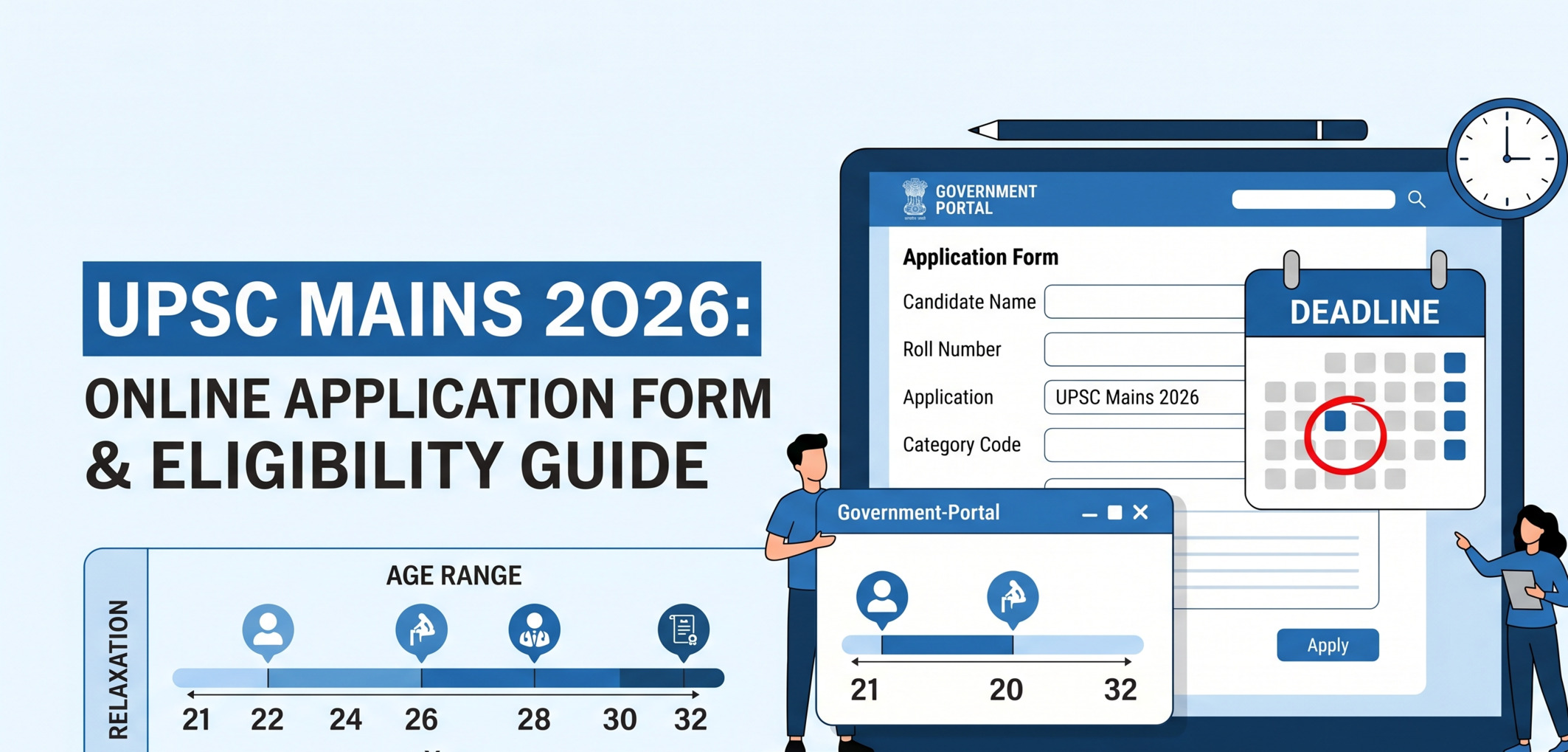
If you cleared UPSC Prelims 2026, the real race has just begun — and right now, the most urgent task on your desk is the UPSC Civil Services IAS Mains Online Form 2026. The application link went live on 19 June 2026, and the window closes on 29 June 2026. Miss this date, and there’s no second chance, no matter how hard you’ve worked for Prelims.
This guide walks you through everything you need: the exact dates, eligibility rules, step-by-step form-filling process, document checklist, common mistakes candidates make, and a realistic preparation roadmap for the two months leading up to the Mains exam on 21 August 2026. Whether you’re a first-time aspirant or a repeat candidate fine-tuning your strategy, this article gives you the practical, no-fluff information you actually need.
UPSC Civil Services Mains Exam 2026?
The UPSC Civil Services Examination is conducted in three stages: Preliminary, Mains, and Interview (Personality Test). Only candidates who clear the Prelims cut-off are invited to fill the Mains application — this is called the Detailed Application Form (DAF-I).
The Mains exam tests depth, not just recall. It includes nine descriptive papers — Essay, four General Studies papers, two Optional Subject papers, and two qualifying language papers — designed to evaluate analytical thinking, writing ability, and command over a chosen subject. This stage decides who moves on to the interview round and, eventually, who gets a service allocation in IAS, IPS, IFS, or one of the other Central Civil Services.
Important Dates
Here’s the complete timeline candidates should track closely:
Event
Date
UPSC Prelims 2026 Exam
24 May 2026
Mains Online Form (DAF) Activation
19 June 2026
Last Date to Submit Mains Form
29 June 2026
UPSC Mains 2026 Exam
Starting 21 August 2026 (5 days)
Mains Admit Card Release
Around 15–20 days before the exam
A few points worth noting:
The Mains form is only for candidates who cleared the Prelims cut-off. There’s no separate notification — UPSC directly emails or messages qualified candidates, but it’s safer to check your status yourself on the official portal rather than wait for a notification.
The exam window typically spans five days, so plan personal leave, travel, and accommodation early — hotel and travel costs near exam centers spike close to the date.
Always cross-check dates on upsc.gov.in or upsconline.nic.in, since UPSC occasionally extends deadlines by a day or two due to technical issues.
Eligibility Criteria
Eligibility for the Mains stage mirrors the original Prelims notification, but it’s worth re-confirming before you submit the form.
Age Limit
Minimum Age: 21 years
Maximum Age: 32 years (for the General category)
Candidates must be born not earlier than 2 August 1994 and not later than 1 August 2005
Age Relaxation (as per standard UPSC norms)
OBC: up to 3 years
SC/ST: up to 5 years
PwBD candidates: up to 10 years
Additional relaxations apply for defence personnel, ex-servicemen, and certain J&K domicile candidates for specific exam years
Educational Qualification
A degree from a recognized university, or an equivalent qualification recognized by the Government of India
Final-year students awaiting results can apply provisionally, but must produce proof of having passed the qualifying exam at the time of DAF submission
Number of Attempts
General: 6 attempts
OBC: 9 attempts
SC/ST: Unlimited attempts (within the age limit)
PwBD: Relaxed attempt limits as per category
Practical tip: Many candidates assume the Mains form has separate eligibility from Prelims — it doesn’t. If you had any discrepancy in your Prelims application (like a category certificate issue), resolve it now, because DAF scrutiny is far stricter than Prelims scrutiny.
Fill the Mains Form
Visit the official portal: Go to upsconline.nic.in and log in using your existing One-Time Registration (OTR) credentials — you don’t need to register again.
Check qualification status: Only Prelims-qualified candidates can access the Mains DAF link.
Fill Part I of DAF: Enter personal details, communication address, and confirm your photograph/signature uploaded earlier.
Select your Optional Subject: This is one of the most important choices in the entire exam — choose carefully based on your background, interest, and availability of study material.
Choose exam centre: Pick from the list of available Mains centres; options are usually fewer than Prelims centres, so check availability early.
Fill service and cadre preferences (if applicable): Some cycles allow preliminary preference filling at this stage; follow the on-screen instructions exactly.
Upload required documents: Category certificate, PwBD certificate, or other relevant proofs if applicable.
Review and submit: Double-check every field — once submitted, corrections are extremely limited or not allowed at all for Mains.
Download and save confirmation: Always save a PDF copy of your submitted DAF for your records.
Practical example: A candidate from Lucknow applying for the first time should keep scanned copies of their graduation degree, category certificate (if applicable), and a recent passport-size photo ready before starting the form — this alone saves 30–40 minutes of last-minute scrambling.
Application Fee Details
General/EWS/OBC candidates: ₹100
SC/ST/PwBD/Women candidates: No fee
Payment can be made online via net banking, debit/credit card, or through SBI challan at designated branches (cash mode, where applicable)
Fee once paid is non-refundable, so verify all your details before making the payment.
Documents You’ll Need
Keep these ready in scanned, UPSC-compliant format before you start:
Recent passport-size photograph (as per UPSC’s prescribed size and format)
Scanned signature
Graduation degree / provisional certificate
Category certificate (SC/ST/OBC-NCL, if applicable)
PwBD certificate (if applicable)
Ex-servicemen certificate (if applicable)
Valid ID proof (Aadhaar, PAN, passport, etc.)
DAF — What It Really Means
The Detailed Application Form (DAF) isn’t just a formality — it’s the document UPSC interview boards use to ask you personal questions later. Every detail you fill here, from your hobbies to your work experience, can become an interview question months later.
Insight from successful candidates: Treat the DAF as a mini-introduction to your interview board. Don’t list hobbies or achievements you can’t speak confidently about — interview panels often probe exactly these details.
Common Mistakes to Avoid
Waiting until the last day: Server load spikes in the final 24–48 hours, causing failed submissions. Apply at least 3–4 days early.
Choosing the wrong optional subject under pressure: Don’t pick an optional just because a friend is scoring well in it — match it to your own strengths.
Mismatched details between Prelims and Mains forms: Even minor spelling differences in your name or date of birth can trigger DAF scrutiny issues later.
Ignoring document format guidelines: Photos or signatures that don’t match UPSC’s size/format specs often get rejected during upload.
Not saving the confirmation page: Always download your final submitted form — UPSC support requests often need this as proof.
Forgetting to verify exam centre availability: Mains centres fill up; if your preferred city isn’t selectable, you may be allotted a distant centre.
Preparation Strategy for the Next 60 Days
With roughly two months between the form submission and the actual exam, structure your time wisely:
Weeks 1–3: Foundation and Optional Subject
Revise your optional subject syllabus thoroughly — this carries 500 marks (two papers of 250 each)
Start daily answer writing practice, even if it’s just 2–3 questions a day
Weeks 4–6: General Studies Deep Dive
Focus on GS papers (Governance, Ethics, Economy, International Relations, Environment)
Use current affairs from the last 12 months — link them to static syllabus topics
Weeks 7–8: Mock Tests and Revision
Join a structured Mains test series for at least 8–10 full-length mocks
Get answers evaluated by mentors or peer groups — self-evaluation alone won’t reveal blind spots
Revise the Essay paper separately; many candidates underprepare for it
Daily Habits That Matter
Newspaper reading focused on editorial analysis, not just headlines
Answer writing under timed conditions (this builds speed for the actual 3-hour papers)
Short daily revision of static portions (Polity, Geography, History) to avoid last-minute cramming
Conclusion
The UPSC Civil Services Mains Online Form 2026 is a narrow but critical window — ten days that decide whether your months of Prelims preparation translate into a real shot at the services. Fill the form carefully, keep your documents ready, and don’t leave submission to the last moment. More importantly, use the weeks between now and the Mains exam on 21 August 2026 wisely: prioritize answer writing, revise your optional subject, and stay consistent with current affairs. Civil services success rarely comes from cramming in the final week — it comes from steady, focused preparation starting today.
Author – Ritesh Ranjan: Indian Institute of Technology Madras has achieved another major milestone in its journey to make quality higher education more accessible, flexible and future-ready. The IIT Madras BS Degree Programmes recently celebrated 1,460 learners who became eligible to receive degrees and diplomas at a special convocation held on the institute’s campus. The event marked not only the academic success of the graduating learners but also the growing impact of digital-first and blended higher education in India.
The convocation highlighted how the IIT Madras BS Programmes are helping reshape the traditional idea of higher education. By offering flexible learning pathways, strong academic support and access to IIT-quality education beyond the physical campus, the programmes have opened new opportunities for students, working professionals, entrepreneurs and lifelong learners.
A Milestone for Flexible Higher Education
The graduating cohort included 634 BS Degree recipients, 197 BSc Degree recipients, 604 Diploma recipients and 25 Postgraduate Diploma recipients. In addition, 173 students were recognised with Certificates of Academic Distinction and Merit for their outstanding academic performance.
These numbers reflect the scale and seriousness with which learners are engaging with the programme. Unlike conventional full-time campus degrees, the IIT Madras BS Degree Programmes allow students to learn at their own pace while continuing with other academic, professional or personal commitments. This flexibility has made the programmes especially important for students who may not be able to relocate, pause their work or follow a traditional residential education model.
The ceremony also celebrated inspiring family milestones, including father-son and mother-son pairs graduating together. Such stories reflect the inclusive and lifelong nature of the programme, where learning is not limited by age, background or location.
Strong Focus on Social Inclusion
One of the most important aspects of the IIT Madras BS Programmes is their reach among learners from diverse economic backgrounds. Among the graduating learners, 101 students came from families with annual incomes between ₹1 lakh and ₹5 lakh, while 221 students belonged to families earning less than ₹1 lakh annually.
This is a powerful example of how technology-enabled education can expand access to high-quality learning. For many students, financial limitations often become a barrier to higher education, especially when it comes to premier institutions. However, through institutional scholarships, CSR support and flexible learning structures, IIT Madras has made it possible for thousands of learners to pursue education at reduced or even no cost.
The social impact of the programme is also visible in its active learner base. Around 25% of active learners come from families earning below ₹1 lakh annually, while another 15% come from families earning between ₹1 lakh and ₹5 lakh. These figures show that the programme is not only academically strong but also socially meaningful.
One of the World’s Largest Non-Campus Higher Education Initiatives
The IIT Madras BS Degree Programmes have grown into one of the world’s largest non-campus higher education initiatives. Today, the programmes have more than 42,000 active learners from India and several other countries.
Learners come from all Indian states and union territories, as well as from abroad. More than 50% of learners are pursuing the programme alongside another degree, while around 14% are working professionals. This diverse learner base includes college students, professionals, entrepreneurs and people who are returning to education after a gap.
This scale is important because it proves that high-quality education can be delivered beyond the boundaries of a physical campus. With the right academic design, evaluation model and learner support, online and blended education can become a serious alternative to traditional models.
Building Talent for India’s Future
Speaking at the convocation, Prof. V. Kamakoti, Director of IIT Madras, congratulated the graduating learners and highlighted the importance of emerging fields such as Data Science, Electronic Systems, Aeronautics and Space Technology, and Management. He noted that these areas will play a critical role in India’s future growth and in the vision of Viksit Bharat 2047.
The IIT Madras BS Programmes are designed to create future-ready talent in these high-demand fields. With India rapidly expanding its digital economy, deep-tech ecosystem, space sector and data-driven industries, there is a growing need for skilled professionals who can solve real-world problems.
Dr. Pratyush Kumar, Co-founder and CEO of Sarvam AI, also addressed the graduating cohort. He encouraged students to focus not just on jobs but on innovation, deep technology and value creation at scale. His message reflected the larger purpose of the programme: to prepare learners to become creators, innovators and problem-solvers.
Student Innovation and Global Recognition
The annual report of the BS Programmes showcased several impressive student achievements. Shriprasad, Saranath and Shruthi, students of the BS in Data Science and Applications, won first place at the EconUnion Validation Challenge. They received a ₹1 lakh prize along with a sponsored trip to Switzerland.
Another student, A.K. Deepankar, won USD 20,000 at the RevenueCat Shipaton 2026 Hackathon for building an app called Bloom. These achievements show that students from the programme are not only learning theory but also applying their knowledge in competitive and innovation-driven environments.
Students of the IIT Madras BS Programmes have also won contests and participated in challenges linked to Mark Rober Jugaad, ISRO, IIT Bombay, Anthropic and Google. Such recognition at national and international platforms strengthens the reputation of the programme as a launchpad for innovation, entrepreneurship and technical excellence.
Redefining the Future of Higher Education
The IIT Madras BS Degree Programmes represent a new model of higher education in India. They combine the academic strength of a premier institution with the flexibility of digital learning. This makes the programmes suitable for a wide range of learners, including students from smaller towns, working professionals, economically disadvantaged learners and those seeking to upskill in emerging areas.
The success of the latest convocation shows that flexible education does not mean compromising on quality. Instead, it can create more pathways for serious learners to access rigorous academic training and industry-relevant skills.
As India moves towards becoming a knowledge-driven economy, such models will become increasingly important. The IIT Madras BS Programmes are not just producing graduates; they are building confidence, opportunity and future-ready talent for India and the world.
Conclusion
The landmark convocation of the IIT Madras BS Degree Programmes is more than a celebration of 1,460 graduands. It is a reflection of how higher education is evolving in India. With strong social inclusion, flexible pathways, academic rigour and a growing culture of student innovation, IIT Madras is setting a powerful example for digital-first education.
By reaching learners from diverse regions, age groups and income backgrounds, the programme is proving that world-class education can be more inclusive and scalable. As the graduates move forward, they carry not just degrees and diplomas, but the skills and confidence to contribute to India’s future.
FAQs
1. What are the IIT Madras BS Degree Programmes?
The IIT Madras BS Degree Programmes are flexible higher education programmes offered by IIT Madras in emerging fields such as Data Science, Electronic Systems, Aeronautics and Space Technology, and Management. They are designed to make quality education accessible to learners beyond the traditional campus model.
2. How many learners were honoured at the IIT Madras BS Programmes convocation?
A total of 1,460 learners became eligible to receive degrees and diplomas at the special convocation held on the IIT Madras campus.
3. What degrees and diplomas were awarded during the convocation?
The graduating cohort included 634 BS Degree recipients, 197 BSc Degree recipients, 604 Diploma recipients and 25 Postgraduate Diploma recipients.
4. Why are the IIT Madras BS Programmes important for social inclusion?
The programmes support learners from diverse economic backgrounds. Many students come from families with annual incomes below ₹1 lakh or between ₹1 lakh and ₹5 lakh. Scholarships and CSR support have helped thousands study at reduced or no cost.
5. Who can benefit from the IIT Madras BS Degree Programmes?
The programmes are useful for students pursuing another degree, working professionals, entrepreneurs and lifelong learners who want flexible access to high-quality education in future-ready fields.