

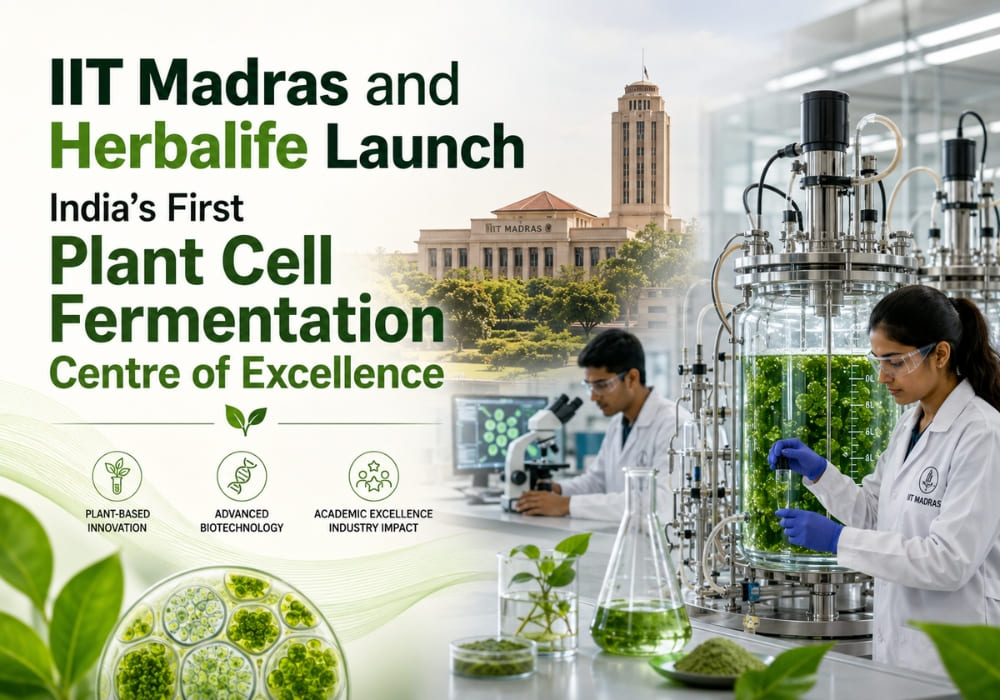
Author – Ritesh Ranjan: The Indian Institute of Technology Madras, in collaboration with Herbalife International India Pvt. Ltd., has launched the Herbalife–IIT Madras Centre of Excellence on Plant Cell Fermentation Technology. Inaugurated on 22 June 2026, this new facility is being described as India’s first dedicated centre for translational research and innovation in plant cell fermentation. The initiative marks a significant step in India’s journey toward sustainable biomanufacturing, herbal innovation and next-generation plant-derived health products.
As the global demand for natural ingredients, herbal extracts and environmentally responsible production methods continues to rise, plant cell fermentation is emerging as a promising scientific solution. The new Centre of Excellence at IIT Madras aims to strengthen India’s capability in this advanced area by supporting research, training, innovation, technology transfer and commercial-scale development.
A New Milestone in Sustainable Biomanufacturing
The Herbalife–IIT Madras Centre of Excellence has been created to serve as a national hub for plant cell fermentation technology. Its primary objective is to enable the sustainable and scalable production of herbal biomass, enriched extracts and high-value phytochemicals. These plant-derived compounds are widely used in nutraceuticals, health and wellness products, herbal formulations and specialty ingredients.
Traditional methods of producing plant-based compounds often depend on agriculture, seasonal conditions, land availability and wild harvesting. These methods can sometimes create pressure on natural resources and biodiversity. Plant cell fermentation offers an alternative by allowing specific plant cells to be cultivated in controlled environments. This can help produce valuable natural compounds with greater consistency, reduced environmental impact and better scalability.
The new centre at IIT Madras is expected to play a vital role in bridging the gap between laboratory research and industrial application. By combining academic expertise with industry support, the initiative aims to move scientific discoveries from the lab to pilot-scale and eventually to market-ready solutions.
Why Plant Cell Fermentation Matters
Plant cell fermentation is an advanced bioprocessing technique that uses plant cells to produce natural compounds under controlled conditions. Instead of cultivating whole plants in fields, scientists can grow plant cells in bioreactors and guide them to produce useful phytochemicals. This approach can reduce dependence on large-scale farming and wild collection while ensuring a more reliable supply of plant-derived ingredients.
This technology is especially relevant for sectors such as health and wellness, nutraceuticals, herbal extracts, cosmetics, food ingredients and specialty bio-based products. Many natural compounds used in these industries are difficult to extract in large quantities through traditional cultivation. Plant cell fermentation can help overcome this challenge by offering a cleaner, more sustainable and more efficient production route.
The Herbalife–IIT Madras Centre of Excellence will use customized plant cell bioreactors, downstream processing systems and advanced analytical platforms. These tools will support research into commercially viable plant-based ingredients and high-value phytochemicals. The centre is also expected to promote innovation in metabolomics, process optimization and scalable biomanufacturing.
Supporting India’s Bioeconomy Vision
The launch of the Centre of Excellence aligns with India’s broader national vision for biotechnology-led growth. It supports policy initiatives such as BioE3, Atmanirbhar Bharat and sustainable bio-manufacturing. These initiatives aim to strengthen India’s domestic scientific capabilities, reduce import dependence and encourage innovation-driven economic development.
By building indigenous expertise in plant cell fermentation, India can become more competitive in the global bioeconomy. The centre can help develop technologies that support sustainable production of natural ingredients while also opening new opportunities for start-ups, researchers and industry partners.
The facility is expected to contribute to intellectual property generation, start-up creation, technology transfer and entrepreneurship. These outcomes are important because scientific research creates greater value when it can be translated into products, services and commercial applications.
Strong Industry-Academia Partnership
The inauguration of the Herbalife–IIT Madras Centre of Excellence was attended by key leaders from science, industry and regulatory bodies. Prominent participants included Dr. N. Kalaiselvi, Director General of CSIR and Secretary, DSIR; Prof. V. Kamakoti, Director of IIT Madras; Shri Virendra R. Tiwari, Chairperson of the National Biodiversity Authority; and Mr. Ajay Khanna, Managing Director of Herbalife India.
Their presence highlighted the national importance of the initiative. The centre represents a strong example of industry-academia collaboration, where scientific knowledge, institutional infrastructure and industry experience come together to solve real-world challenges.
Prof. Ashwin Mahalingam of IIT Madras described the partnership as an example of how academia and industry can create long-term national assets. He noted that the centre’s advanced research infrastructure can help expand the possibilities of plant cell bioprocessing and convert scientific progress into meaningful social impact.
From Laboratory Research to Market Applications
One of the most important strengths of the Herbalife–IIT Madras Centre of Excellence is its translational focus. The centre is not limited to basic academic research. It has been designed to help move ideas from laboratory scale to pilot scale and then toward commercial and societal use.
This approach can benefit researchers, students, entrepreneurs and companies working in the field of plant-derived ingredients. Start-ups and industry professionals may be able to use the centre’s infrastructure to validate technologies, improve processes and develop market-ready products.
According to Prof. Smita Srivastava, who heads the centre, the CoE will accelerate innovation, nurture talent and strengthen India’s leadership in commercial plant cell fermentation. She emphasized that the centre will support capacity building, entrepreneurship and academia-industry collaboration, helping India become a global hub in this emerging field.
Facilities and Research Capabilities
The Herbalife–IIT Madras Centre of Excellence is equipped with customized plant cell bioreactors, advanced analytical platforms and pilot-scale processing systems. These facilities will support the cultivation of plant cells, extraction of valuable compounds, process optimization and quality analysis.
The centre’s infrastructure is expected to help researchers explore new plant-derived products and improve the production of existing herbal compounds. It can also support training programs for students and professionals who want to build expertise in plant cell fermentation and sustainable biomanufacturing.
By offering access to high-end scientific tools, the centre can encourage collaboration between academia, industry and start-ups. This can strengthen India’s innovation ecosystem and help convert research outcomes into practical solutions.
Regulatory and Commercial Future
The inauguration also included panel discussions on the commercial future and regulatory landscape of plant cell fermentation. Experts from India, Germany and the UK discussed global opportunities, scientific progress and the importance of clear rules for scaling fermentation-derived herbal products.
Regulation will play a crucial role in the growth of this sector. As plant cell fermentation evolves, quality standards, safety frameworks and industry readiness will determine how quickly products can reach the market. The new Centre of Excellence can become an important platform for shaping discussions around best practices, commercial viability and responsible innovation.
Conclusion
The launch of the Herbalife–IIT Madras Centre of Excellence on Plant Cell Fermentation Technology is a major development for India’s biotechnology and wellness sectors. As India’s first dedicated centre for translational research in this field, it has the potential to advance sustainable biomanufacturing, support herbal innovation and create new opportunities for plant-derived health products.
By combining IIT Madras’ academic strength with Herbalife’s industry experience, the centre can help build a strong ecosystem for research, entrepreneurship, technology transfer and commercial application. In the coming years, this initiative may play an important role in positioning India as a global leader in plant cell fermentation and sustainable bio-based innovation.
FAQs
1. What is the Herbalife–IIT Madras Centre of Excellence?
The Herbalife–IIT Madras Centre of Excellence is a dedicated research and innovation facility focused on plant cell fermentation technology. It aims to support sustainable production of herbal biomass, enriched extracts and high-value phytochemicals.
2. When was the Centre of Excellence launched?
The Centre of Excellence was inaugurated on 22 June 2026 at IIT Madras in collaboration with Herbalife International India Pvt. Ltd.
3. Why is plant cell fermentation important?
Plant cell fermentation allows valuable natural compounds to be produced using plant cells in controlled environments. It can reduce dependence on traditional agriculture and wild harvesting while supporting sustainable and scalable production.
4. Who can benefit from this centre?
Researchers, students, start-ups, entrepreneurs, industry professionals and companies working on herbal extracts, nutraceuticals, wellness products and plant-derived ingredients can benefit from the centre’s infrastructure and expertise.
5. How does this initiative support India’s biotechnology sector?
The centre supports India’s goals of sustainable biomanufacturing, indigenous innovation, technology transfer and entrepreneurship. It can help reduce import dependence and strengthen India’s position in the global bioeconomy.
Next article
NSUT Admission 2026 guide eligibility, JEE Main entrance details, JAC Delhi counselling dates, selection process, cutoffs & documents