
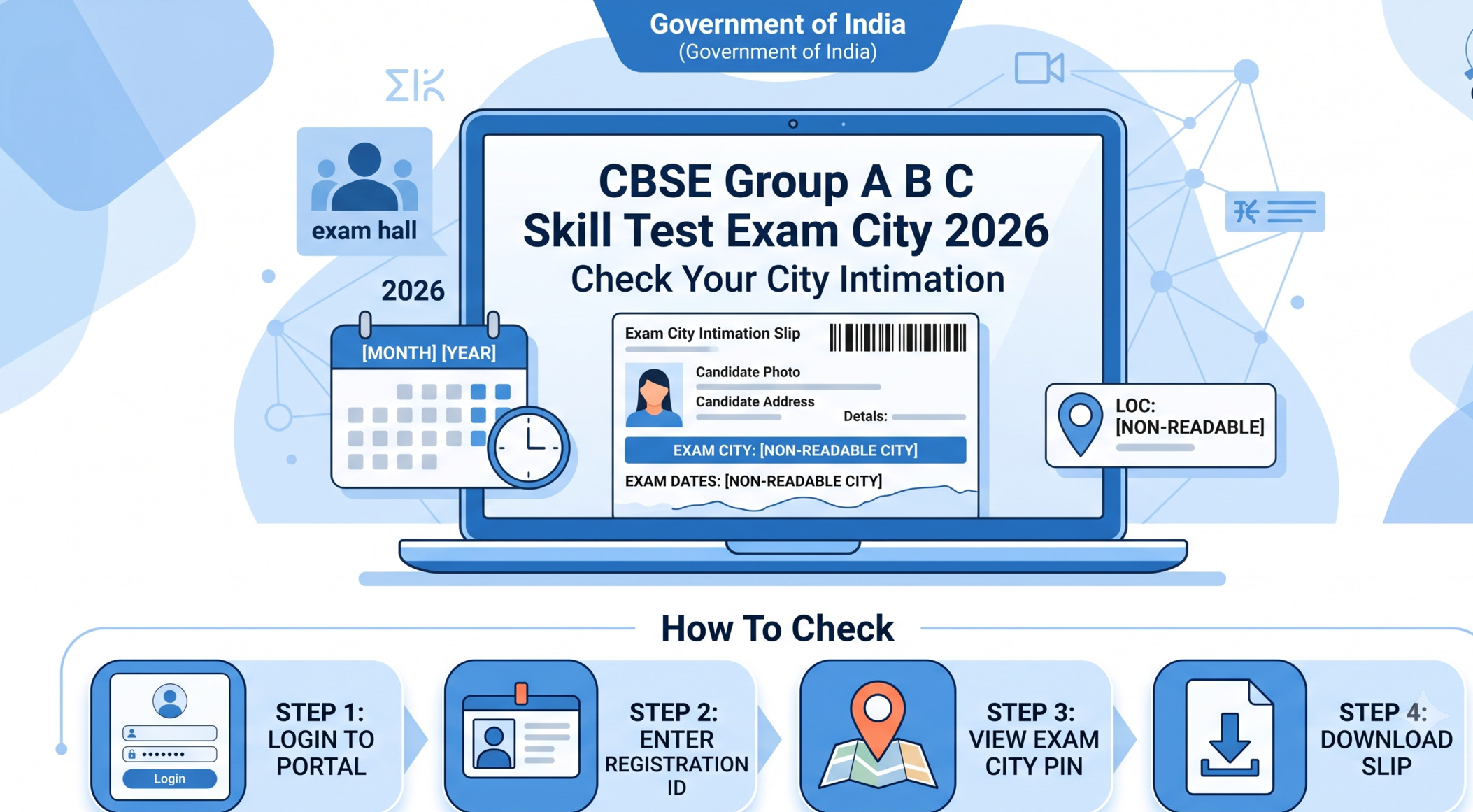
If you applied for the CBSE Group A, B, and C recruitment drive and cleared the earlier stages, you’re probably refreshing the CBSE website every few hours right now, waiting for one thing: your exam city slip for the Skill Test.
That waiting game ends here. This guide walks you through everything connected to the CBSE Group A, B, C Skill Test Exam City Details 2026 — how to check it, what dates to keep in mind, who is eligible for the skill test stage, and the small mistakes that trip up otherwise well-prepared candidates every year.
By the end of this article, you’ll know exactly where to click, what documents to keep ready, and how to walk into your typing/skill test centre with zero last-minute panic.
What Is the CBSE Group A, B, C Skill Test?
The Central Board of Secondary Education (CBSE) conducts recruitment for various administrative and academic posts under Group A, B, and C categories — including Assistant Secretary, Accounts Officer, Superintendent, Junior Translation Officer, Junior Accountant, and Junior Assistant.
The selection process runs in stages: Tier-I (objective screening), Tier-II (for select posts like Superintendent), a qualifying Skill Test, and an Interview (only for Group A roles). The Skill Test is essentially a practical check — mostly a typing test — for posts where day-to-day work involves data entry, correspondence, and computer-based recordkeeping.
It doesn’t add marks to your final score, but it’s a make-or-break qualifying hurdle. Miss the benchmark speed, and your Tier-I or Tier-II performance won’t save you.
Why the Exam City Detail Matters
Before the admit card arrives, CBSE releases an Exam City Intimation Slip — a short document confirming only the city (not the exact venue) where your test will happen. This isn’t a formality. It exists so candidates can:
Book train or flight tickets early, before prices spike
Arrange accommodation near the test city
Avoid the scramble of last-minute travel planning
Cross-check that their preferred city choice (submitted during the application) was actually allotted
Skipping this check is one of the most avoidable mistakes candidates make — some end up booking travel to the wrong city entirely, based on assumption rather than verification.
Who Needs to Appear for the Skill Test
The skill test isn’t mandatory for every post. Based on the official selection pattern, it applies mainly to:
Junior Assistant
Junior Accountant
Senior Assistant / Stenographer categories
Superintendent (as part of the broader Tier-I, Tier-II, Skill Test sequence)
Posts like Assistant Secretary, Assistant Professor, and Accounts Officer typically move from the written exam stage directly to interview, without a skill/typing component.
Important Dates at a Glance
Event
Status/Date
Online Application Window
December 02 – December 27, 2025
Application Correction Window
December 29–30, 2025
Tier-I Written Exam
January 31 & February 1, 2026
Tier-I Result
March 2, 2026
Tier-II Exam City Slip Released
April 8, 2026
Tier-II Admit Card
April 15, 2026
Tier-II Exam
April 18, 19, 25 & 26, 2026
Tier-II Result
May 15, 2026
Skill Test / Typing Test
Expected shortly after Tier-II/Tier-I results, post-specific
Skill Test scheduling and city-slip release dates vary by post, since not every candidate reaches this stage at the same time. Always cross-check your own login for your applicable timeline — treat the table above as a reference, not a guarantee.
Eligibility Criteria
General eligibility (age reckoned as on the cut-off date specified in the notification) varies by post:
Assistant Secretary: 18–35 years
Accounts Officer: 18–35 years
Assistant Professor / Assistant Director: 18–30 years
Superintendent: 18–30 years
Junior Translation Officer: 18–30 years
Junior Accountant: 18–27 years
Junior Assistant: 18–27 years
For the skill test specifically, posts like Junior Assistant and Junior Accountant require a typing speed of 35 words per minute in English or 30 words per minute in Hindi on a computer. This is qualifying — you either clear the benchmark or you don’t; there’s no partial credit.
Standard age relaxation applies for SC/ST, OBC, PwBD, and other reserved categories as per government norms.
How to Check Your Exam City Details
Visit the official CBSE website: cbse.gov.in
Click on the “Recruitment” tab in the top menu.
Find and select the relevant link — usually labelled something like “Group A, B, C Exam City / Skill Test Details 2026.”
On the login page, enter your Application Number / Enrollment Number and Date of Birth.
Enter the security PIN/captcha shown.
Click Submit — your exam city (and later, your full admit card) will display on screen.
Download the slip and save at least two copies — one digital, one printed.
Keep this simple rule in mind: the city slip tells you where to travel; only the admit card tells you which exact centre and what time. Don’t finalize local transport until the admit card is out.
Documents to Carry on Test Day
Printed admit card/hall ticket
A valid original photo ID (Aadhaar, PAN, Voter ID, or Passport)
Passport-size photographs (same as used during application, if instructed)
Category/PwBD certificate, if applicable
A face mask or personal hygiene kit, if required by current centre guidelines
Carrying only the city intimation slip is not sufficient for entry — CBSE explicitly requires the admit card for gate entry.
Tips to Prepare for the Skill/Typing Test
Practice on a full-size keyboard daily, not just your phone. Typing rhythm on a physical keyboard is different from touchscreen typing.
Time yourself with 10-minute mock passages to build both speed and accuracy under pressure.
Don’t chase speed at the cost of errors — most skill tests have an accuracy threshold alongside the words-per-minute requirement.
Familiarize yourself with the software typically used in CBSE test centres (usually a standard DOEACC/NIELIT-style typing tool).
Reach the centre at least 45–60 minutes early to avoid rushed, anxious typing.
Common Mistakes Candidates Make
Assuming the exam city slip and admit card are the same document — they’re not.
Waiting until the last day to download the slip, then facing server overload.
Practicing typing only in English when the post allows a Hindi option (or vice versa), missing an easier qualifying route.
Not verifying spelling of name/DOB on the slip — errors here can cause entry issues later.
Ignoring SMS/email alerts from CBSE, then missing narrow correction windows.
Latest Updates and Trends
CBSE has increasingly moved city and admit card releases to a staggered, post-specific schedule rather than one blanket release date, since different posts reach the skill-test stage at different times. Skill test venues are typically concentrated in major hubs — cities like Delhi, Mumbai, Bengaluru, Hyderabad, Kolkata, Chennai, Pune, Lucknow, Jaipur, and Chandigarh have historically hosted the bulk of CBSE recruitment testing infrastructure, based on past cycles.
Given the qualifying (non-scoring) nature of the skill test, candidates who clear Tier-I/Tier-II with strong margins are advised not to treat the typing stage casually — disqualification here overrides a good written score entirely.
Key Takeaways
The Skill Test is a qualifying stage — no marks are added to your final merit, but failing it ends your candidacy regardless of written exam performance.
Only Junior Assistant, Junior Accountant, Superintendent, and similar posts require this stage.
The exam city slip is released before the admit card — always check both separately.
Typing benchmark: 35 wpm (English) or 30 wpm (Hindi).
Always verify details directly on cbse.gov.in; third-party sites can carry outdated or incorrect information.
Conclusion
The CBSE Group A, B, C Skill Test stage might feel like a small technical checkpoint compared to the written exams, but it’s just as decisive. Treat the exam city slip and admit card as two separate must-check documents, keep your typing practice consistent in the weeks leading up to test day, and always confirm dates directly f
Author – Ritesh Ranjan: IIT Madras – A new multi-institute study led by the Indian Institute of Technology Madras has brought attention to an important issue in India’s justice system: the need for more women police officers to handle gender-based crime cases. The study shows that greater female representation in policing can improve victim trust, increase reporting of crimes and make justice delivery more sensitive and effective.
Gender-based crimes, especially domestic violence, sexual harassment and abuse within private spaces, often remain underreported. Many survivors hesitate to approach the police because of fear, social stigma, family pressure or lack of confidence in the system. In such situations, the presence of women police officers can make a significant difference.
According to the Bureau of Police Research and Development, women made up only 11.75% of India’s police force in 2022. This underrepresentation is a major concern because policing is one of the first points of contact for victims seeking justice. When survivors feel uncomfortable, unsafe or unheard at the police station, they may choose silence over complaint.
Why Women Police Officers Matter
The IIT Madras-led study argues that female police officers can help create a more responsive and empathetic policing environment. Victims of gender-based crimes often need not only legal support but also psychological comfort and dignity during the complaint process.
Women officers are often seen as more approachable in sensitive cases. Their presence can help survivors feel more secure while sharing painful personal experiences. This is especially important in cases involving sexual violence, domestic abuse or marital conflict, where victims may struggle to speak openly to male officers.
The researchers found that higher female representation in policing can improve institutional trust. When victims believe that the police will listen to them without judgment, they are more likely to report crimes. This can lead to better documentation, stronger investigations and improved chances of justice.
Prof. Kandaswamy Paramasivan of IIT Madras noted that women’s participation in policing helps increase trust and reporting rates among victims of gender-based crimes. He also highlighted that women officers can influence police culture by bringing more victim-sensitive and responsive practices into the system.
A Step Towards Victim-Centred Policing
A diverse police force is not just a matter of representation. It can directly affect how justice is delivered. In gender-based crime cases, the attitude of the police can shape the entire experience of the survivor.
If a victim is dismissed, blamed or pressured into silence, the justice process can fail at the very first stage. But when police officers respond with empathy, professionalism and seriousness, victims are more likely to continue with the legal process.
Women officers can play a crucial role in building this victim-centred approach. Their involvement can reduce fear, encourage honest communication and help police departments understand the emotional and social realities faced by survivors.
However, the study also makes it clear that simply recruiting more women is not enough. Women officers must be given proper training, authority and leadership opportunities. They should not be limited to symbolic roles or only assigned to “women-related” duties without real decision-making power.
The ADR Paradox
One of the important warnings raised by the study is about the use of Alternative Dispute Resolution, or ADR, in gender-based crime cases. ADR refers to informal methods such as mediation, counselling or settlement, which are sometimes used instead of formal legal action.
The study found that some women police officers may encourage mediation or informal settlement, especially in cases involving married women. This may be done with the intention of preserving family stability or reducing pressure on the legal system.
However, this approach can become problematic when serious crimes are handled too informally. If a victim wants to file a formal complaint, her choice must be respected. Pushing her towards compromise can weaken legal accountability and may place her at further risk.
Prof. Thangatur Sukumar Hariharan explained that ADR should be used carefully and only when appropriate. The victim’s preference must remain central. If a survivor wants legal action, the police must support that decision rather than direct her towards settlement.
This is especially important in domestic violence cases, where repeat abuse is common. Informal settlements may give offenders a sense that they can escape punishment. Therefore, while ADR may have a role in certain situations, it should never replace justice in serious gender-based crimes.
Training, Leadership and Institutional Support
The study highlights that meaningful reform requires more than increasing recruitment numbers. Dr. Nabila Khan of IIM Lucknow pointed out that women officers need leadership opportunities, specialised training, institutional support and accountability systems.
This means female officers should be trained in handling sensitive complaints, trauma-informed interviewing, legal procedures and victim protection. They should also be placed in senior investigative and supervisory roles so they can influence how cases are handled at a deeper level.
Mr. S. Thejaswin of SRM Institute of Science and Technology added that women’s presence in policing is not only about meeting quotas. It is about building a trustworthy institution. Female officers can offer psychological comfort to survivors, but lasting change will happen only when they are empowered within the system.
Police departments must ensure that women officers are not restricted to desk roles or token positions. They should be part of investigations, leadership teams, training units and policy decisions. Only then can their presence create structural change.
Policy Support and Future Reforms
India has already taken several steps to improve women’s participation in policing. These include reservation policies, recruitment orders, maternity leave, childcare leave and healthcare benefits. Such measures have helped increase visibility, but the pace of change remains slow.
The IIT Madras-led study recommends more focused reforms. These include specialised training in gender-based crime handling, independent reviews of police performance, awareness campaigns and stronger conviction rates.
Public awareness is also important. Victims must know their rights and understand that they can demand formal legal action. Communities must be encouraged to support survivors rather than silence them through stigma or pressure.
At the same time, police departments must be held accountable for how they respond to gender-based crime complaints. Regular audits, transparent reporting and survivor feedback mechanisms can help improve trust.
Conclusion
The IIT Madras-led study offers an important reminder that justice is not only about laws. It is also about the people who enforce those laws and the way they respond to victims.
Increasing the number of women police officers can improve trust, reporting and sensitivity in gender-based crime cases. But recruitment alone is not enough. Women officers must be trained, empowered and placed in meaningful roles within the police system.
A justice system that listens to survivors, respects their choices and responds with seriousness can make a real difference. More women in policing can be a powerful step towards that goal, but only when supported by strong policies, institutional reform and a clear commitment to victim-centred justice.
FAQs
1. What does the IIT Madras study say about women police officers?
The study says that increasing women’s representation in policing can improve victim trust, encourage reporting of gender-based crimes and make justice delivery more sensitive.
2. Why are women police officers important in gender-based crime cases?
Women officers can make survivors feel safer and more comfortable while reporting sensitive crimes such as domestic violence, sexual abuse and harassment.
3. What is the ADR paradox mentioned in the study?
The ADR paradox refers to the risk of using mediation or informal settlement too often in gender-based crime cases, which may weaken legal accountability.
4. Is recruiting more women police officers enough?
No. The study says women officers also need specialised training, leadership opportunities, institutional support and authority in investigation roles.
5. What reforms does the study recommend?
The study recommends gender-sensitive training, independent reviews, awareness campaigns, stronger conviction rates and better leadership roles for women police officers.